





A 'Steam World' Confirmed
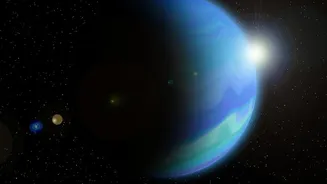
The latest groundbreaking discovery centres on an exoplanet named GJ 9827 d, located approximately 98 light-years away in the constellation Pisces. While hints of water were previously detected by the Hubble Space Telescope, new, detailed observations
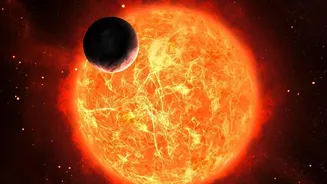
from the JWST have confirmed that the planet's atmosphere is significantly rich in water vapour. Researchers are calling it the first confirmed example of a 'steam world'—a long-theorised type of planet with a dense, water-heavy atmosphere. The finding is significant because, at roughly twice the diameter of Earth, GJ 9827 d is the smallest exoplanet to date where such a detailed atmospheric composition has been measured.
Meet Planet GJ 9827 d
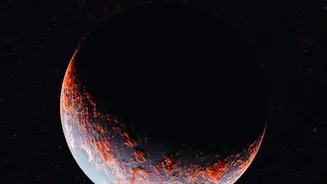
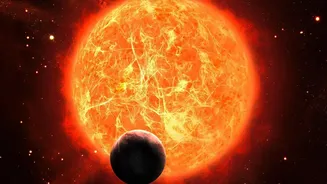
First discovered by the Kepler Space Telescope in 2017, GJ 9827 d orbits its red dwarf star in a very tight loop, completing a full year in just 6.2 Earth days. This close proximity means the planet is incredibly hot, with temperatures estimated to be around 425 degrees Celsius—comparable to Venus. Because of this intense heat, the water exists as scorching steam, making the planet inhospitable for life as we know it. Despite its hellish conditions, the planet provides a crucial natural laboratory for understanding planetary atmospheres. Scientists had two main theories: either it was a 'mini-Neptune' with a puffy, hydrogen-dominated atmosphere containing some water, or a rocky world that had lost its hydrogen and retained a heavier, water-rich atmosphere.
How Webb Made the Discovery
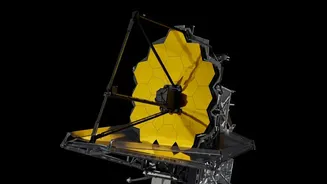
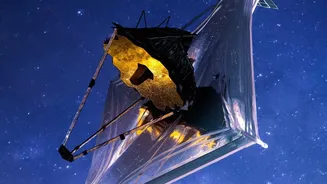
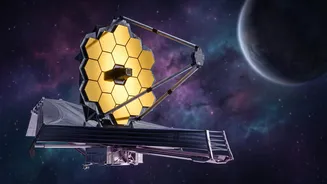
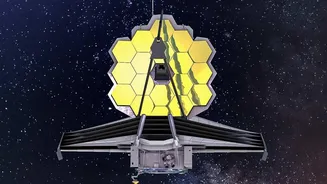
To settle the debate, an international team of astronomers used Webb's Near-Infrared Imager and Slitless Spectrograph (NIRISS), a Canadian-led instrument. They employed a technique called transmission spectroscopy. As GJ 9827 d passed in front of its host star, the telescope captured the starlight filtering through the planet's atmosphere. Different molecules absorb light at specific wavelengths, leaving a unique chemical fingerprint. The data from Webb was exceptionally clear, showing a strong signature of water and, crucially, a lack of the hydrogen that dominates the atmospheres of gas giants. This allowed scientists to conclude that GJ 9827 d's atmosphere is dense and composed of heavier molecules, with water being a primary component.
A Major Step for Planetary Science
This discovery marks a pivotal shift in exoplanet research. Previously, detailed atmospheric studies were largely limited to giant planets. Probing the skies of smaller, rocky or semi-rocky worlds was a significant challenge. The confirmation of a water-rich atmosphere on a planet just twice Earth's size demonstrates Webb's unprecedented capability. According to the research team, led by Caroline Piaulet-Ghorayeb of the University of Montréal's Trottier Institute for Research on Exoplanets, this is a huge step toward the goal of analysing atmospheres on smaller, more Earth-like planets. It proves that worlds with atmospheres compositionally similar to terrestrial planets like Earth or Venus—rich in heavier elements rather than just hydrogen—exist and can be studied in detail.
What Comes Next in the Search for Life?
While GJ 9827 d itself is not a candidate for life, its existence and composition are profoundly important for the bigger picture. It confirms that planets can form and retain significant amounts of water, a key ingredient for life. By successfully detecting and characterising a 'steam world', astronomers have sharpened the tools and techniques they will use to scrutinise other, more promising targets. The focus will now be on finding similar-sized planets that orbit within their star's 'habitable zone'—the temperate region where liquid water could potentially exist on a planet's surface. This discovery on a hot, steamy world is a critical stepping stone toward the ultimate goal: finding a truly Earth-like planet with an atmosphere that could support life.