




The Ghostly Sparkle in Question
The latest celestial showstopper comes from the James Webb Space Telescope (JWST), which has turned its powerful infrared eyes on a cosmic celebrity: Cassiopeia A (Cas A). What it captured is a breathtakingly detailed image of a colourful, chaotic cloud
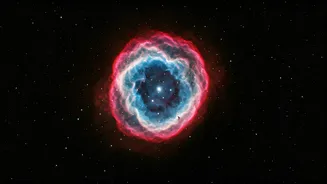
of gas and dust. This isn't a star, but the ghost of one. Cas A is a supernova remnant, the glowing, expanding debris left behind after a massive star exploded. The image reveals intricate filaments of bright orange and delicate pink, resembling cosmic fireworks frozen in time. This is the “dazzling sparkle” that has astronomers and stargazers buzzing, but its beauty hides a violent and ancient past.
Your Sky Is a Time Machine
Here's the mind-bending part: the explosion that created Cas A happened long ago, but its light is only just reaching us. Located about 11,000 light-years away, the light we see from this event today actually began its journey 11,000 years ago. However, there's another layer. We know the star exploded around 340 years ago from our perspective on Earth. The light from that cataclysmic event has been travelling across the cosmos ever since. Think of it like receiving a letter in the post that was sent centuries ago. The light particle, or photon, leaves its source—the exploding star—and travels at the fastest speed possible. But space is vast. So, for 340 years, that light has been racing towards us. What the JWST captured isn't what Cas A looks like today; it's what it looked like in the late 17th century, around the time the Taj Mahal was being completed.
The Violent Birth of Beauty
So, what caused this celestial masterpiece? A supernova is one of the most powerful events in the universe. It occurs when a star at least five times more massive than our Sun runs out of fuel. Its core collapses under its own immense gravity, and then it rebounds in a spectacular explosion. This blast is so powerful that it forges heavy elements—like the calcium in our bones and the iron in our blood—and flings them out into space. The expanding shockwave from the explosion ploughs through the surrounding interstellar gas, heating it up and causing it to glow brilliantly across the spectrum. The intricate web of colours seen in the JWST image of Cas A corresponds to different chemical elements and temperatures, giving scientists a 'map' of the star’s final moments.
Why This Image Is a Big Deal
Beyond its sheer beauty, the new image of Cas A is a treasure trove of scientific data. By studying the composition and structure of the remnant, astronomers can learn more about the life cycle of massive stars. The JWST's infrared capabilities allow it to see through clouds of dust that would obscure the view of other telescopes, revealing never-before-seen details. Scientists are particularly interested in cosmic dust within the remnant. This dust, forged in the heart of the dying star, contains the raw materials for forming new stars and planets. In a very real sense, the building blocks for future worlds—and perhaps life itself—are being sifted through in the aftermath of this ancient explosion. Studying Cas A is like performing a cosmic autopsy to understand the origins of the elements that make up our own planet.