



Why Catch a Rocket?
SpaceX already perfected landing its Falcon 9 boosters on drone ships and concrete pads. So why the radical change for Starship’s much larger Super Heavy booster? The answer lies in two of aerospace's biggest hurdles: weight and time. Adding landing legs
to a vehicle the size of Super Heavy would add several tonnes of mass that serves no purpose during ascent. By removing the legs and leaving the 'catching gear' on the ground as part of the launch tower, SpaceX frees up that mass, allowing the rocket to carry more payload. The second reason is speed. SpaceX's goal is airline-style reusability, flying the same rocket multiple times a day. Landing a booster at sea requires ships, cranes, and a multi-day logistical process to get it back to the launch pad. Catching the booster directly at the tower means it can theoretically be placed back on the launch mount, restacked with the spaceship, and be ready for its next flight in a matter of hours, not days.
The Challenge of Pinpoint Accuracy
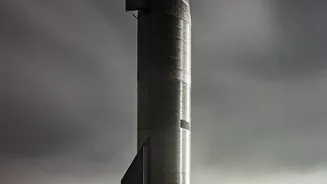
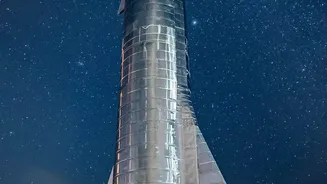
The entire manoeuvre hinges on almost unbelievable precision. The Super Heavy booster, after separating from the Starship upper stage, performs a series of engine burns to fly itself back to the launch site. In the final moments of its descent, it must use its Raptor engines to slow from over 1,000 km/h to a near-hover right next to the tower. The capture window—the 'box' the booster has to fly into—is estimated to be only a few metres wide. Any deviation caused by wind, engine performance, or atmospheric conditions must be corrected in real-time. This is a monumental control engineering challenge, where thousands of corrections are made every second to ensure the 71-metre-tall vehicle arrives at the exact right spot, at the right velocity, and at the right orientation.
Meet 'Mechazilla': The Tower and its Chopsticks
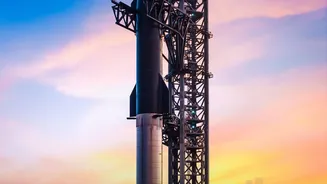
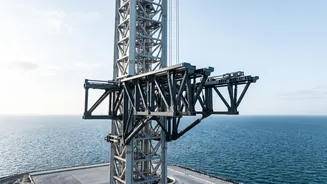
The system responsible for the catch is a 146-metre-tall launch and integration tower, nicknamed 'Mechazilla' by CEO Elon Musk. Attached to this tower are two massive steel arms, often called the 'chopsticks'. These arms are not static; they are mounted on a carriage that can move up and down the tower and can also swing open and closed. As the booster descends into position, the arms, which are spread wide, close in to secure the vehicle at two reinforced hard points near its grid fins. These points are already structurally robust to handle aerodynamic forces, saving the need for dedicated catch hardware on the booster itself. The arms are actuated by powerful hydraulic systems designed to absorb the momentum of the returning vehicle and hold it steady.
The Brains Behind the Brawn
The physical hardware is only half the story. The success of the catch depends on a sophisticated suite of sensors and software. The booster uses a combination of GPS and Inertial Measurement Units to determine its position, velocity, and orientation. However, this data can be 'noisy' or prone to errors. To get a true picture, SpaceX employs sensor fusion techniques, like a Kalman filter, which combine data from multiple sources to produce the most accurate possible estimate of the booster's state. This refined data is fed into the flight computer, which commands the Raptor engines and grid fins to make the continuous, tiny adjustments needed to hit the target. The feedback loop between sensing the rocket's position and commanding a correction must happen at incredibly high frequencies to counteract any disturbances.
From Booster to Ship
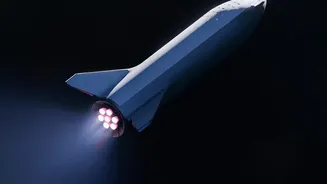
While SpaceX has already successfully caught the Super Heavy booster on its first attempt in October 2024, that is only part of the full vision. The next, and significantly harder, step is to catch the Starship upper stage as well. Unlike the booster, which performs a relatively short flight, the ship returns from orbital velocity. This means it must endure the intense heat of atmospheric reentry before attempting a similar precision landing and catch. Successfully catching both stages is the key to unlocking the fully and rapidly reusable system that forms the entire economic basis for the Starship program, from launching satellites to enabling future missions to the Moon and Mars.