



The Core of the Kayak Stroke
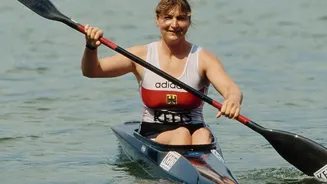
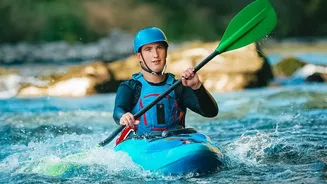
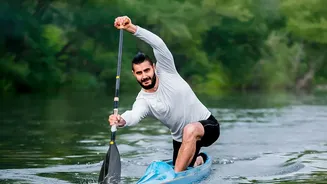
At first glance, kayaking looks like an all-arms activity. In reality, a powerful and efficient kayak stroke originates from your core. The primary motion is a rotation of the torso, where you push with one arm and pull with the other. Think of your arms and shoulders
as connectors that transfer power generated by your larger back and abdominal muscles. Your legs and hips are also active, pressing against foot pegs to provide stability and help rotate your torso, ensuring your entire upper body works as a single, powerful unit. This technique allows for sustained effort over long distances with less fatigue.
Paddleboarding's Full-Body Engagement
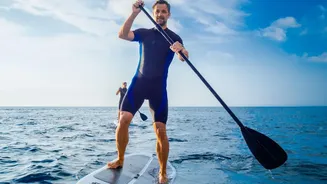
Stand-up paddleboarding (SUP) is a true full-body workout that starts from the ground up. The simple act of balancing on the board constantly engages your feet, legs, and deep core muscles to maintain stability. Unlike kayaking's double-bladed paddle, the single SUP paddle requires you to reach forward, 'catch' the water, and pull your body past the paddle. An effective stroke uses your lat muscles, obliques, and hips as the primary drivers, not just your arms and shoulders. This makes it a comprehensive workout that challenges balance and strength simultaneously.
Two Different Core Workouts
Both sports are excellent for building core strength, but they do it in different ways. Kayaking creates rotational strength. Because you're seated in a stable position, the workout focuses intensely on the obliques and abdominals as you twist with every stroke. Your lower back muscles also work to maintain posture. Paddleboarding, on the other hand, is about core stabilization. Your core must fire continuously to keep you balanced on an unstable surface, even before you take a single stroke. The paddling motion adds a rotational challenge on top of this constant balancing act, engaging nearly every muscle in your midsection.
The Truth About Shoulder Effort
Both activities involve the shoulders, but the nature of the effort and the risk of strain differ based on technique. In kayaking, the repetitive push-pull motion engages the deltoids and back muscles. Paddleboarding also works the shoulders, but proper technique emphasizes using your larger back muscles (lats) to pull, rather than lifting with your shoulders. For both sports, poor form is the main culprit behind shoulder strain. Inexperienced paddleboarders, for example, tend to rely too heavily on their shoulder joints instead of engaging their hips and core. Conversely, proper technique in both sports is designed to take the load off the smaller shoulder muscles and place it onto the much stronger core and back.
Legs: Bracing vs. Balancing
The role of the lower body is a key differentiator. In a kayak, your legs are not passive. They are actively bracing against the inside of the boat, providing the leverage needed for powerful torso rotation. In contrast, your entire lower body is critical for paddleboarding. Your feet and ankles are constantly making micro-adjustments to maintain balance, while your quads, hamstrings, and glutes are engaged to absorb chop and transfer power from your core to the paddle. This makes SUP a more complete lower-body activity compared to the upper-body and core focus of kayaking.
Which Paddle Is for You?
Choosing between kayaking and paddleboarding depends on your fitness goals and personal preference. If your aim is a robust upper-body and rotational core workout that can be sustained over long distances, kayaking is an excellent choice. Its lower center of gravity also makes it more stable, especially in wind and chop. If you're seeking a comprehensive, full-body workout that heavily challenges your balance, core stabilizers, and legs, stand-up paddleboarding has the edge. It provides a unique combination of strength, balance, and endurance training in a single activity.