





A Glimpse Into Other Worlds
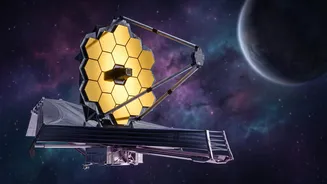
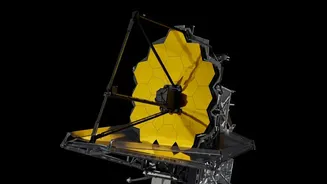
Scientists using the revolutionary JWST have identified the chemical signature of water vapour in the atmosphere of an exoplanet, a planet that orbits a star other than our sun. While water has been found on gas giants before, finding its signature around
a rocky, albeit larger, planet is a thrilling development. The discovery confirms that a key ingredient for life as we know it can exist in the atmospheres of rocky worlds in other star systems. This breakthrough was made possible by Webb's unparalleled ability to parse the light filtering through the atmosphere of a planet hundreds of light-years away.
What Exactly Are Super-Earths?
The term 'super-Earth' refers to a class of planets more massive than Earth but significantly smaller than our solar system's ice giants like Neptune. These planets are among the most common types discovered in our galaxy, yet none exist in our own solar system, making them objects of intense scientific curiosity. They pose a fascinating puzzle for astronomers; it's unclear if they are more like giant, rocky versions of our own world or small, gassy versions of Neptune. Some, like 55 Cancri e, are incredibly hot, with surfaces that are likely molten oceans of magma. Others, like the more temperate GJ 1214 b, have long been theorised to be potential 'water worlds' with deep global oceans.
The Power of Infrared Vision
This remarkable feat was achieved using a technique called transit spectroscopy. As the exoplanet passes in front of its host star, the star's light filters through the planet's atmosphere. The powerful instruments aboard the JWST, specifically its spectrographs that read infrared light, analyse this light with incredible precision. Every chemical element and molecule absorbs light at unique wavelengths, creating a sort of chemical 'barcode' in the light's spectrum. By reading this barcode, astronomers can determine the composition of a planet's atmosphere from light-years away. In this case, the instruments picked up the distinct, tell-tale signs that can only be attributed to water molecules.
Water, But Not Habitable... Yet
It is crucial to temper excitement with a dose of scientific reality. The presence of water vapour does not automatically mean the discovery of life or even a habitable ocean world. Many super-Earths, including recent subjects of study like 55 Cancri e and GJ 486 b, orbit very close to their stars, resulting in scorching surface temperatures that would make liquid water impossible. For example, 55 Cancri e has a dayside temperature of about 2,800 degrees Fahrenheit, and its surface is likely a bubbling ocean of magma. Similarly, the planet GJ 486 b has a surface temperature around 430 degrees Celsius. These worlds are far too hot to be habitable in the way we understand it.
A Key Ingredient, A Vital Clue
So, why is this discovery so important? The significance is not that these specific planets are habitable, but that Webb has proven its ability to detect this vital molecule on rocky worlds. It shows that even on planets blasted by intense heat and radiation, a gaseous atmosphere can be sustained. This could provide a unique window for studying the interactions between atmospheres, surfaces, and the interiors of rocky planets. These findings could even offer insights into the early conditions of planets in our own solar system like Earth, Venus, and Mars, which are thought to have been covered in magma oceans in their distant past. It adds a critical piece to the puzzle of how planets form and evolve.