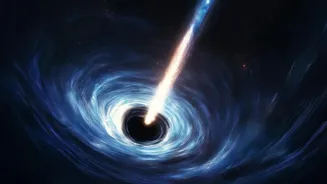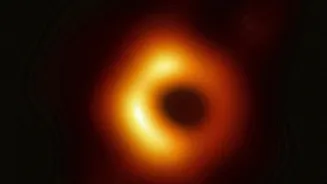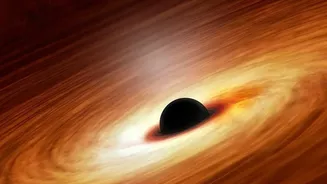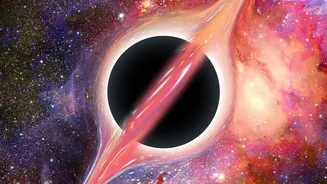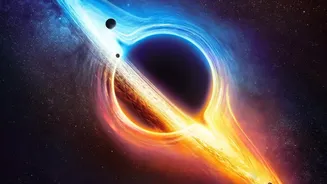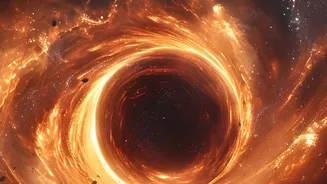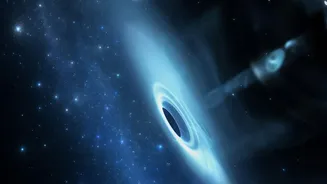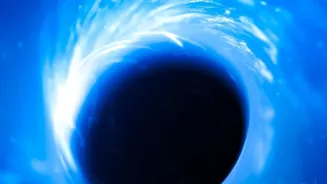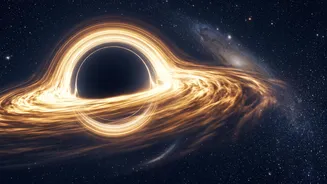




In the cosmic rulebook, black holes are known for merging, not splitting. They collide and grow larger, never smaller. But new theoretical research suggests there might be a loophole, a set of extreme conditions that could allow one to divide.
The Universe's Toughest Law?
For decades,
our understanding of black holes has been governed by a seemingly unbreakable rule: they only get bigger. When two black holes collide, they merge to form a single, more massive one. This idea is tied to a fundamental concept in physics known as the second law of thermodynamics, which, when applied to black holes, suggests their total surface area—and by extension, their entropy or disorder—can never decrease. A single black hole splitting into two smaller ones would violate this principle, as the combined surface area of the two new holes would be less than that of the original. This has made the idea of black hole 'fission' a theoretical impossibility under normal circumstances, a process that is simply forbidden by the laws of physics as we know them.
A Loophole Involving Extreme Spin
A recent study published in the journal 'Physical Review D' has proposed a fascinating exception to this rule. A team of physicists has calculated that a loophole could exist, but it requires a very specific and extreme condition: the black hole must be spinning at, or very near to, its maximum possible speed. This incredible rate of rotation changes the physics involved. The energy from the spin alters the relationship between the black hole's mass and its entropy. Under these conditions, a split becomes thermodynamically favourable, meaning it no longer violates the law of entropy. It opens a tiny window where the impossible might just become possible.
The 'Pair-of-Pants' Split
The researchers have even modelled what such a split might look like. They describe the process using a curious term: a 'pair-of-pants topology'. If a black hole were to divide, its event horizon—the point of no return—would stretch and contort into a shape resembling a pair of trousers. The original black hole represents the 'waist', which then separates into two 'legs', with a new, smaller black hole emerging from each one. However, even with the right spin, there's another major hurdle. The two newly formed black holes must be able to fly apart fast enough to escape each other's immense gravity. If they don’t, they would simply fall back together and merge again. This requirement makes the conditions even more precise, narrowing the possibility to only those black holes rotating at the absolute physical limit.
Beyond Our Four Dimensions
While extreme spin offers one potential path to black hole division, another even more exotic possibility involves extra dimensions. Some advanced theories in physics, like string theory, propose that our universe may have more than the three spatial dimensions we experience. In theoretical models with additional dimensions, physicists have found that black_hole_like objects can become unstable and break apart. In these higher_dimensional scenarios, a split can become thermodynamically favourable, especially if one of the resulting black holes is much smaller than the other. It is important to remember that this remains purely theoretical. There is currently no evidence that our universe has these extra dimensions or that such processes occur within it.
Why Study an Impossible Event?
While we are unlikely to ever witness a black hole splitting, this research is far from a mere academic curiosity. Exploring these theoretical boundaries is crucial for testing the limits of our most fundamental theories, including Einstein's theory of general relativity. According to the researchers, the probability of a split depends on how gravity behaves beyond what Einstein described. They suspect that smaller, primordial black holes, which are hypothesised to have formed at the very beginning of the universe, might be more likely to split than the massive ones we observe today. It’s possible that such an event could release a detectable burst of high_energy gamma_rays, offering a potential, indirect way to find evidence. By pushing these theories to their breaking point, physicists hope to uncover clues that could lead to a more complete understanding of gravity and the cosmos.