






First, What Is El Niño?
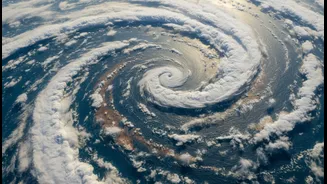
El Niño is one phase of a naturally occurring climate pattern called the El Niño-Southern Oscillation (ENSO). In a normal, or neutral, year, trade winds blow from east to west across the tropical Pacific, pushing warm surface water towards Asia and Australia.
This allows cooler, deeper water to rise up along the coast of South America. During an El Niño, which happens every two to seven years, these trade winds weaken. As a result, the warm water sloshes back eastward, piling up along the west coast of the Americas. This change in ocean temperature disrupts atmospheric circulation, altering weather patterns across the globe, often causing droughts in some regions and heavy floods in others. Its counterpart, La Niña, involves the opposite: stronger-than-usual trade winds and a cooling of the eastern Pacific.
A Cycle Amplified by a Warming World
While El Niño is a natural phenomenon, its relationship with human-caused climate change is a major focus of ongoing scientific research. The core question is whether a warmer planet is making El Niño events more frequent or more intense. While there isn't complete scientific consensus, many recent studies suggest that global heating may be leading to stronger El Niño events. The 2023-24 El Niño was one of the five strongest on record, and these powerful events seem to be happening more often. Human-induced climate change is warming our oceans and atmosphere, which can intensify some of El Niño's impacts. For example, when an El Niño occurs on top of already high global temperatures, it can contribute to record-breaking heat and make extreme weather even more likely.
A Global Climate Laboratory
For climate scientists, a strong El Niño event is like a massive, uncontrolled experiment. It provides a rare opportunity to see how Earth's systems respond to a major, temporary shift in heat distribution. Researchers are using the data from recent events to test and refine their climate models. According to the World Meteorological Organization (WMO), there's a high probability of another El Niño developing and strengthening rapidly through the latter half of 2026. This provides yet another chance for observation. Scientists are particularly interested in studying how El Niño affects global temperatures, rainfall patterns, and the ability of oceans and forests to absorb carbon dioxide. The insights gained help improve everything from seasonal weather forecasts to long-term climate projections.
The New Frontiers of Research
The renewed focus on El Niño is driving research in several key areas. One major goal is improving the accuracy of climate models. Researchers have long known there is an asymmetry in the ENSO cycle—El Niño warming tends to be stronger than La Niña cooling—and models have struggled to capture this. Recent studies are exploring smaller-scale factors, like daily swings in sea surface temperature, to better simulate this imbalance and improve future predictions. Another area of intense study is the potential for El Niño to trigger long-lasting "climate regime shifts"—abrupt, persistent changes in regional climates that don't just disappear when the El Niño fades. Understanding these potential tipping points is crucial for preparing for a warmer future where strong El Niños may become more common.