





The Inevitable Tug of Earth
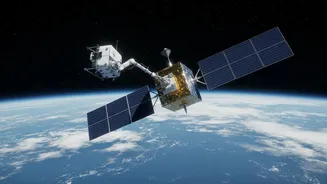
Satellites in low-Earth orbit, an area that extends up to about 2,000 kilometers, aren't in a perfect vacuum. They constantly run into sparse atmospheric gas molecules. While the air is incredibly thin, the high orbital speeds of satellites—around 7.8
kilometers per second—mean these tiny collisions add up. This creates a persistent drag force that slows the satellite down, causing its orbit to gradually decay. To counteract this, satellites must fire thrusters to boost themselves back up, a process that consumes precious onboard fuel. For missions like the International Space Station or the Hubble Telescope, this requires regular re-boost maneuvers. The amount of fuel a satellite can carry is one of the primary limits on its operational lifespan; once the fuel runs out, its mission is effectively over.
A Satellite That Breathes
Imagine a satellite that never runs out of fuel because it uses the atmosphere itself as propellant. This is the core concept behind Air-Breathing Electric Propulsion, or ABEP. Instead of carrying a finite supply of a propellant like xenon, an ABEP system is designed to scoop up the very atmospheric particles that cause drag and use them to generate thrust. This ingenious approach turns a persistent problem into a limitless resource. The idea could enable a new class of long-duration missions, allowing satellites to operate in very low orbits (below 400-450 km) for years, potentially for as long as their electronic components survive. Researchers at the European Space Agency (ESA) and other institutions have been developing and testing this technology, proving its feasibility in simulated space environments.
From Drag to Thrust
The process sounds like science fiction, but it works on established principles. An ABEP system consists of two main parts: a specialized intake and an electric thruster. The intake is designed to passively collect and compress the rarefied air molecules as the satellite speeds through orbit. These captured gases, primarily nitrogen and oxygen, are then channeled into the thruster. Inside the thruster, the gas is ionized—meaning the atoms are given an electrical charge, turning the gas into a plasma. A powerful electric or magnetic field then accelerates these charged particles and ejects them at high speed, producing a continuous, gentle push that counteracts the atmospheric drag. In ground tests, ESA successfully ignited a thruster using a nitrogen-oxygen air mixture, observing the engine's plume change from the blue of xenon to a distinct purple, proving the concept worked.
The Promise of Perpetual Flight
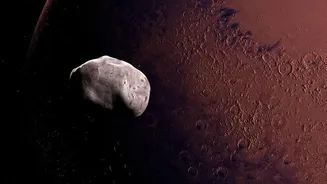
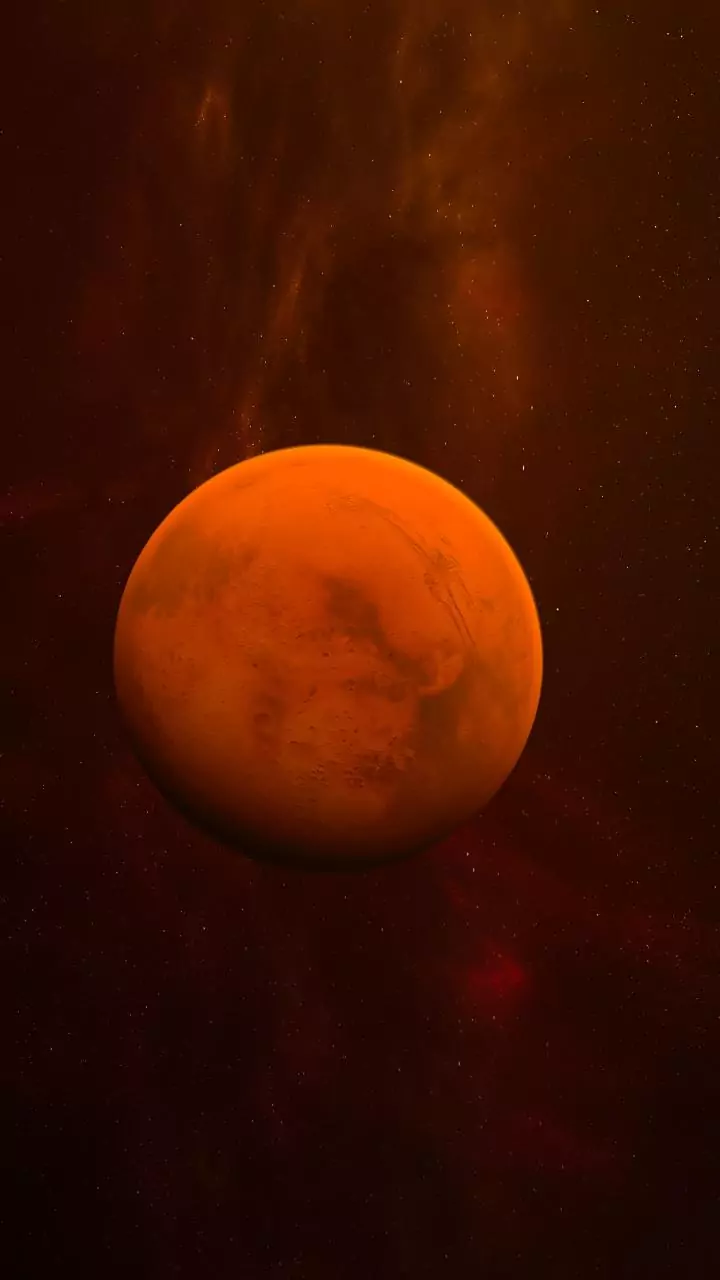
The implications of mastering ABEP technology are enormous. For satellite operators, it represents a fundamental shift in mission economics. Satellites could become more sustainable, with lifespans limited by hardware durability rather than fuel capacity. Operating in very low-Earth orbit (VLEO) offers significant advantages, including higher-resolution imagery for Earth observation satellites and lower latency for communication networks. Furthermore, this technology could help mitigate the growing problem of space debris. VLEO is a 'self-cleaning' orbit; the higher drag means that any debris or defunct satellites will deorbit and burn up in the atmosphere relatively quickly. By enabling sustained operations in this region without adding to long-term debris, ABEP promotes a more responsible use of space. The technology isn't limited to Earth; it could one day be adapted for missions to Mars, using the red planet's thin carbon dioxide atmosphere as propellant.
Challenges on the Horizon
Despite successful ground tests, bringing air-breathing propulsion from the lab to orbit involves significant technical hurdles. The intake must be incredibly efficient at collecting enough particles in an extremely sparse environment. The thruster itself must be able to reliably ionize and accelerate atmospheric gases, which are more difficult to work with than a uniform propellant like xenon. Additionally, the atomic oxygen present at these altitudes is highly corrosive, which poses a durability challenge for the materials used in the intake and thruster systems. Researchers are actively working to optimize designs, improve collection efficiency, and develop materials that can withstand the harsh VLEO environment for years on end. Achieving a thrust-to-drag ratio greater than one is the key to making these systems practical for maintaining and even raising a satellite's orbit.