


A Groundbreaking Return From Ryugu
It feels like a lifetime ago, but in December 2020, the scientific community was electrified when a small capsule landed in the Australian desert. Inside was a precious cargo: about 5.4 grams of dust and pebbles from Ryugu, a C-type asteroid more than
300 million kilometres from Earth. This was the culmination of the Japan Aerospace Exploration Agency's (JAXA) Hayabusa2 mission. The samples were pristine, untouched by Earth's atmosphere. Analysis over the following years revealed stunning discoveries within this dark dust. Scientists found not just traces of water, but also more than 20 types of amino acids—the building blocks of proteins. In a landmark finding, they even identified uracil, a key component of RNA, which is essential for all known life. These discoveries gave a major boost to the theory that the essential ingredients for life on Earth may have been delivered by asteroids billions of years ago.
An Encore: The Hayabusa2 Extended Mission
For most missions, returning such revolutionary samples would be the grand finale. But JAXA had other plans for its remarkably resilient spacecraft. With fuel and functioning instruments to spare, Hayabusa2 was directed back into deep space for an ambitious extended mission, dubbed 'Hayabusa2#'. Instead of retiring, the veteran explorer was tasked with visiting two more near-Earth asteroids. This new phase was designed to push the spacecraft's capabilities far beyond its original design parameters. The goal was no longer to land and collect samples, but to perform incredibly fast and precise flybys, gathering a different kind of valuable data. The first target on this new itinerary was a 450-metre-wide asteroid formerly known as 2001 CC21, which was given a new name for its big moment.
Meet Torifune: A Peanut-Shaped Oddity
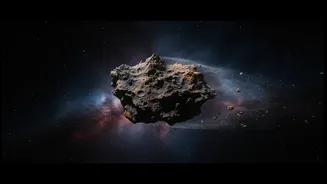
The asteroid was officially named Torifune, after a god and his ship in Japanese mythology known for travelling safely at high speeds—a fitting tribute for the mission ahead. Early in July 2026, Hayabusa2 executed its flyby, and the first images revealed a scientific surprise: Torifune is a 'contact binary', meaning it's formed from two smaller asteroids that have gently fused together, giving it a distinct peanut-like shape. This makes it structurally different from the spinning-top shape of Ryugu. Torifune is also believed to be a different class of asteroid, likely an S-type (silicate-rich) asteroid, whereas Ryugu was a C-type (carbon-rich). By studying a new type of asteroid up close, scientists gain crucial 'scientific context' for their Ryugu findings, helping them understand the diversity of these small worlds and how they formed in different parts of the early solar system.
A High-Speed, High-Stakes Maneuver
The Torifune flyby, which occurred on July 5, 2026, was a masterclass in navigation. Hayabusa2 passed the asteroid at a relative speed of about 5 kilometres per second, or a blistering 18,000 kilometres per hour. This presented a huge technical challenge. The spacecraft was originally designed for rendezvous missions, which involve slowly approaching and hovering near a target. It was not built for a high-speed chase. JAXA engineers had to develop new guidance techniques to ensure the probe could get incredibly close—within 800 meters of Torifune's center—without colliding, all while snapping images and collecting data with its instruments. The successful maneuver demonstrated a new capability for a mission already famed for its precision.
New Science and Planetary Defense
The flyby served two vital purposes. Scientifically, it provides a second data point in our understanding of asteroids. Comparing the composition, density, and structure of Torifune with Ryugu enriches our knowledge of the solar system's formation. But the mission had another, more immediate purpose: planetary defense. To protect Earth from a potentially hazardous asteroid, we first need to be able to reach it. By proving it could precisely navigate a high-speed flyby, Hayabusa2 tested the exact skills needed for a future 'kinetic impactor' mission—one that could intercept and deflect a threatening space rock. The mission is a crucial step in building a planetary defense toolkit, a capability that benefits all of humanity. Hayabusa2's journey is not over, either; it is now on its way to a final target, the tiny asteroid 1998 KY26, which it is scheduled to reach in 2031.