





The Orbital Junkyard Above
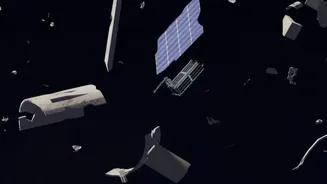
For decades, we have been launching rockets and satellites, leaving behind a trail of waste. This includes everything from defunct satellites and spent rocket stages to tiny flecks of paint and metal fragments from collisions. There are an estimated 170
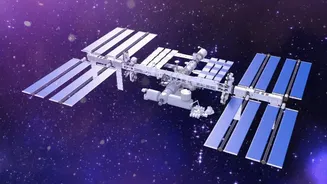
million pieces of debris, most too small to track but still incredibly dangerous. Traveling at speeds over 27,000 km/h, even a small object can strike with the force of a grenade, disabling costly satellites and endangering space stations. This growing problem, sometimes called the Kessler Syndrome, warns of a potential cascade where collisions create more debris, making low Earth orbit unusable.
The Harpoon: An Ancient Tool for a Modern Problem
To capture large, tumbling pieces of debris like old satellites, scientists are turning to a surprisingly old invention: the harpoon. Missions like the European Space Agency's (ESA) RemoveDEBRIS have successfully tested this concept in orbit. The idea involves a 'chaser' spacecraft that fires a tethered harpoon into a piece of debris. Once embedded, the tether allows the chaser to control the target, pulling it into a new trajectory that sends it to burn up in Earth's atmosphere. Companies like Airbus have designed harpoons to be robust, capable of piercing satellite panels and deploying barbs to ensure a firm grip without creating significant new debris.
Lighting the Way: Lasers as Cosmic Brooms
While harpoons are great for large objects, lasers offer a contactless solution for a wider range of debris sizes. This method, known as laser ablation, involves hitting a piece of debris with a powerful, focused laser beam from the ground or a chaser satellite. The laser doesn't destroy the object but vaporizes a tiny part of its surface, creating a small jet of plasma. This jet acts like a thruster, gently pushing the debris and altering its orbit. Over time, repeated nudges can lower an object's orbit enough for it to naturally re-enter and burn up in the atmosphere. Researchers are developing sophisticated systems that can track and target thousands of objects, making this a promising method for clearing smaller, more numerous pieces of junk.
A Growing Toolkit for Active Debris Removal
Laser and harpoon systems are part of a broader suite of technologies being developed for what is known as Active Debris Removal (ADR). Other concepts being tested include giant nets to scoop up debris, robotic arms for grabbing specific targets, and powerful magnets for capture. Some companies, like Japan's Astroscale, are developing servicing satellites that can capture and de-orbit multiple pieces of debris in a single mission, with launches planned for 2026. The goal is to create a versatile toolkit where the right method can be chosen for the specific type of debris being targeted, from large rocket bodies to swarms of smaller fragments.
Challenges on the Final Frontier
Despite the promising technology, cleaning up space is not simple. The challenges are not just technical but also financial and legal. A key question is who should pay for the removal of debris, much of which was launched decades ago by various nations and private entities. Furthermore, there are issues of ownership; you cannot simply grab another country's defunct satellite without permission. The missions themselves are expensive and complex, requiring precise maneuvers to rendezvous with and capture objects tumbling uncontrollably in the vacuum of space. Developing a sustainable and affordable business model for debris removal is one of the key hurdles the industry is currently working to overcome.