





A New Star in the Serpent's Foot
In early October 1604, a 'new star' suddenly appeared in the constellation Ophiuchus, the serpent-bearer. It was first spotted in Italy on October 9 and recorded by astronomers in China a day later. Within days, it grew so bright that it outshone every
star in the night sky and even the planet Jupiter. For a period, it was visible during the daytime. This celestial visitor, appearing in an era before telescopes, sparked wonder, debate, and fear across different cultures, all trying to make sense of the brilliant intruder in what was believed to be a perfect, unchanging heaven.
Kepler's Meticulous Observations
Though not the first to see it, the event is now famously known as 'Kepler's Supernova' after the German astronomer Johannes Kepler, who began his own detailed observations on October 17. For over a year, Kepler tracked the star's position and brightness with remarkable precision for naked-eye measurements. In his 1606 book, 'De Stella Nova in pede Serpentarii' (On the New Star in the Foot of the Serpent-Bearer), he compiled his and other European astronomers' data. Kepler demonstrated that the star showed no parallax—the apparent shift in position of a nearby object against a distant background. This was crucial proof that the 'new star' was not a comet or an atmospheric phenomenon, but was located far away in the realm of the 'fixed stars'.
A Challenge to Ancient Beliefs
Kepler's findings, alongside a similar supernova seen by Tycho Brahe in 1572, delivered a powerful blow to the long-held Aristotelian view of the cosmos. This ancient model, which had dominated Western thought for centuries, held that the heavens beyond the Moon were perfect and immutable. The sudden appearance of a new star—and its eventual fading—proved that the heavens were, in fact, dynamic. This evidence provided crucial support for a new generation of astronomers like Galileo Galilei, who were beginning to champion the sun-centered model of the universe proposed by Nicolaus Copernicus. The supernova became a catalyst for a profound shift in scientific thought, nudging astronomy towards a more modern, evidence-based framework.
Observations from the East
European astronomers were not the only ones documenting the event. Court astronomers in both China and Korea also kept meticulous records of the 'guest star'. Korean observers, in particular, provided an almost day-by-day account of its changing brightness over many months. These independent records from different parts of the world have been invaluable for modern astronomers. By combining the data from European and East Asian sources, scientists have been able to construct a detailed light curve, charting the supernova's rise to peak brightness and its slow decline over the 18 months it remained visible to the naked eye.
What We Know Today
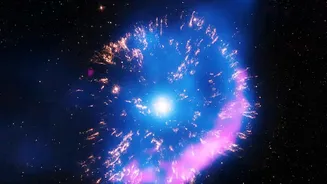
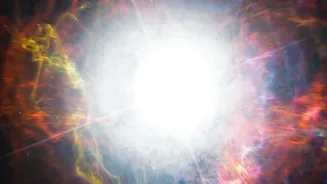
Today, we know that what Kepler and his contemporaries witnessed was not the birth of a star, but its spectacular death. SN 1604 was a Type Ia supernova, the result of a white dwarf star—the dense, burnt-out core of a star like our Sun—exploding. In a binary system, the white dwarf likely pulled material from a companion star until it reached a critical mass, triggering a runaway thermonuclear explosion that obliterated it. Located about 20,000 light-years from Earth, this event remains the most recent supernova to have been definitively observed within our own Milky Way galaxy. Modern telescopes like the Chandra X-ray Observatory and the Hubble Space Telescope continue to study its remnant, a beautiful, expanding cloud of gas and dust, to learn more about these powerful cosmic explosions.