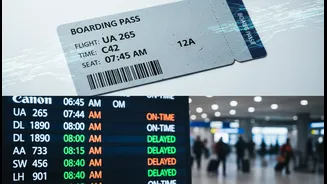









Beyond the Fare: Understanding On-Time Performance
For years, Indian travellers have been conditioned to hunt for the lowest fare. But as our airports get busier, a new, equally important metric is emerging: On-Time Performance, or OTP. Simply put, OTP measures the percentage of flights that arrive or depart
within 15 minutes of their scheduled time. India's aviation regulator, the Directorate General of Civil Aviation (DGCA), officially tracks this data, defining a flight as on-time if it operates within this 15-minute window. A high OTP percentage suggests an airline is better at managing its schedule, which for passengers, means a lower chance of frustrating delays, missed connections, and ruined travel plans.
Where to Find the Official Data
The most reliable source for this information is the DGCA itself. The regulator publishes monthly reports detailing the OTP of scheduled domestic airlines. These reports focus on performance at India's busiest airports, including major hubs like Delhi, Mumbai, Bengaluru, and Hyderabad. These reports provide a transparent, unbiased look at how different airlines are performing in the real world, away from marketing claims. While the official DGCA website is the primary source, several aviation news sites and third-party travel analytics firms like Cirium also analyse and publish this data, often providing broader context and global comparisons.
The Golden Rule: Don't Trust Headline Numbers
Here's the crucial part: an airline's nationwide OTP is only half the story. A carrier might have an excellent overall 85% punctuality rate, but this figure can be misleading. That number is an average of all its flights—from the high-frequency metro routes to quieter regional connections. The reliability of a 7 AM flight from Bengaluru to Delhi on a clear day will be vastly different from a 9 PM flight on the same route during peak monsoon season. Factors like airport congestion, time of day, and weather play a huge role. Mumbai and Delhi airports, for instance, often have lower overall OTP due to heavy traffic and air traffic control restrictions, which can cause a ripple effect across an airline's network.
Be Specific: Check Route, Airport, and Season
To make the data work for you, you need to get specific. The DGCA's data often breaks down performance by airport. Recent reports for May 2026, for example, showed Chennai airport had the highest punctuality at 92.2%, while Mumbai was at the bottom of the top 10 with 70.5%. This tells you that your departure or arrival airport significantly impacts your chances of being on time. If you're flying a critical route, like Mumbai-Delhi for a business meeting, check the airline's performance specifically on that sector if possible. Also, consider the time of year. OTP figures for all airlines tend to drop during monsoon season (July-September) due to rain and in winter (December-January) in North India because of fog. An airline that is punctual in October might struggle in January.
Putting It All Together Before You Book
So, how do you become a smarter flyer? The next time you're booking a flight, add a new step to your process. After you've compared fares, take a few minutes to do a quick OTP check. Look up the latest DGCA monthly report or search for recent news about airline punctuality in India. See which airlines are consistently performing well. In recent months, airlines like IndiGo and Akasa Air have often led the domestic OTP charts according to DGCA data. Air India has also shown significant improvement, ranking highly in some global surveys. An airline's recent performance is a strong indicator of its current operational stability. Choosing a carrier with a proven track record for punctuality, even if it costs a few hundred rupees more, can be a wise investment in a stress-free journey.