





The Universe's Oldest Photograph
The 'ancient light' in question is the Cosmic Microwave Background, or CMB. Often called the afterglow of the Big Bang, it's a faint bath of light that fills the entire cosmos. This light was released when the universe was just 380,000 years old, a mere
infant compared to its current age of 13.8 billion years. Before this moment, the universe was a hot, dense, opaque soup of particles. As it expanded and cooled, atoms formed, and light was set free to travel across space for eternity. Studying the CMB is like looking at a baby picture of the universe, and its subtle variations in temperature and polarization hold clues about the cosmos's origin, evolution, and ultimate fate.
Mapping the Beginning of Time
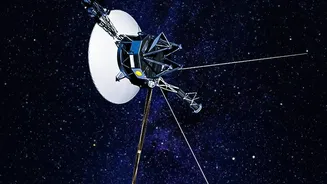
To study this light, you need a very special camera. From 2009 to 2013, the European Space Agency operated the Planck satellite, a space-based observatory designed to map the CMB with higher resolution and sensitivity than ever before. It orbited the sun a million miles from Earth, far from our planet's interfering light and heat. The result was a set of stunningly detailed all-sky maps of the ancient light. These 'Planck maps' are the gold standard for cosmologists, providing a treasure trove of data that scientists are still poring over today to test their theories about the universe.
A Cosmic Twist in the Tale
One of the most profound questions scientists are asking is whether this ancient light has been twisted on its journey to us. Light waves oscillate in a specific direction, a property called polarization. If a fundamental law of physics known as 'parity symmetry' holds true, there should be no preference for this polarization to rotate one way or the other. But what if it does? This theoretical phenomenon is called cosmic birefringence. If observed, it would be like finding that the universe has a subtle handedness, preferring left over right or vice-versa. This would violate parity and point to new physics beyond our current understanding.
The Search for a Cause
What could possibly cause the entire universe to twist light? The most exciting possibility is that this effect is caused by a new, undiscovered field that permeates all of space-time. Such a field could be connected to two of the greatest mysteries in modern physics: dark matter and dark energy. Some theories suggest that hypothetical particles, such as 'axions', could form this field. Axions are leading candidates for dark matter, the invisible substance that makes up about 27% of the universe. Finding evidence of their existence through a rotational effect on light would be a monumental, Nobel-Prize-worthy discovery.
The Latest Verdict on Rotation
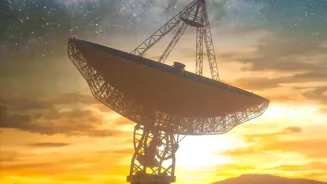
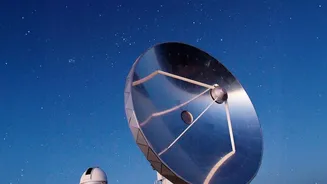
The latest research involves a clever and careful re-analysis of the Planck data. The biggest challenge in measuring this faint cosmic signal is contamination from our own Milky Way galaxy, which is full of dust that emits polarized light. To solve this, scientists are comparing the Planck maps with data from ground-based telescopes, which observe the sky in different light frequencies. By combining these datasets, they can build a more accurate model of the galactic dust and subtract it from the ancient signal. Recent studies have found tantalizing hints of a small but consistent rotation. The evidence is not yet strong enough to be called a discovery, but the fact that different experiments are starting to point toward the same result has the physics community buzzing with excitement.