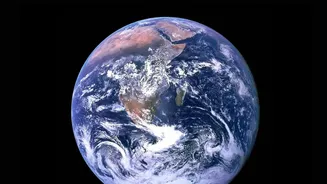

Meet Prithvi: An AI for Planet Earth
At the heart of this innovation is a new 'foundation model' for artificial intelligence, aptly named Prithvi, the Sanskrit word for Earth. Developed through a collaboration between NASA and IBM Research, Prithvi isn't just another AI; it's designed specifically
to understand our planet. Think of it like a large language model, but instead of learning from books and the internet, it has been trained on decades of detailed satellite imagery and Earth observation data from NASA. This massive dataset allows the AI to recognize complex patterns related to weather, climate, and land use on a global scale.
How the AI Model Works
Traditional climate science has long relied on massive supercomputers to run complex physical simulations. While powerful, these methods are incredibly resource-intensive. AI foundation models like Prithvi offer a new, data-driven approach. By analyzing over 40 years of historical information from NASA's archives, the AI learns to identify the subtle connections between different environmental factors. This allows it to do everything from filling in missing data in satellite images to making predictions about future events with remarkable speed and efficiency. Once trained, the model can be fine-tuned for specific tasks using much smaller, localized datasets, a process that can run in seconds on a standard desktop computer.
From Predicting Floods to Tracking Wildfires
The practical applications for this technology are vast and vital. Researchers have already begun using Prithvi for a wide range of tasks, demonstrating its power to improve disaster response and environmental monitoring. For example, the model can be adapted to map the extent of flooding after a hurricane, identify burn scars left by wildfires, and track changes in land use over time. Its capabilities extend to agriculture, with the potential to predict crop yields, and even to unusual challenges like forecasting locust breeding grounds in Africa. This versatility makes it an invaluable tool for understanding and mitigating the real-world impacts of climate events.
Why Open-Source Is a Game Changer
Crucially, NASA and IBM have made Prithvi an open-source model, available for anyone to use and adapt. This decision is central to its potential global impact. By making the tool freely accessible on platforms like Hugging Face, they are democratizing access to cutting-edge climate science. Previously, this level of analysis was only possible for well-funded institutions with access to supercomputers. Now, researchers, non-profits, and governments in any country can leverage this powerful AI to address local and regional environmental challenges. This collaborative approach aims to accelerate scientific discovery and empower communities worldwide to build resilience against climate change.
Potential Benefits for India
For a nation like India, which faces a unique and complex set of climate-related risks, tools like Prithvi could be particularly transformative. The model's ability to improve the resolution of climate simulations and provide more accurate weather forecasting could enhance predictions for the monsoon, a lifeline for the country's agriculture and water supply. Furthermore, its capacity for monitoring land use and environmental changes could aid in managing water resources, tracking deforestation, and developing strategies to combat air pollution in rapidly growing urban centers. By putting these advanced analytical capabilities into the hands of Indian scientists and policymakers, the open-source model supports tailored solutions for the nation's most pressing environmental concerns.