
The Tyranny of Resupply
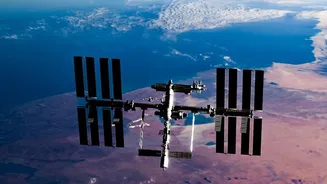
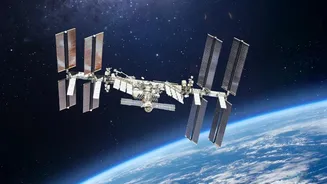
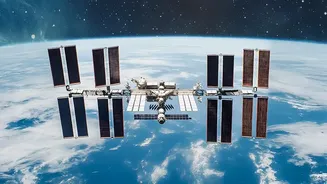
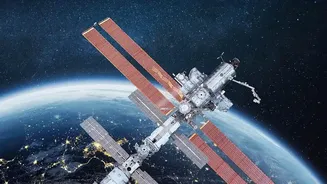
For over two decades, the International Space Station (ISS) has been a testament to human ingenuity, orbiting 400 kilometres above Earth. But it has an umbilical cord. Every drop of water, every breath of air, and every bite of food not recycled onboard
must be launched from the ground. This constant resupply is expensive and logistically complex. For a mission to Mars, which could last up to three years, this model is simply impossible. The distance is too great, and the launch windows are too infrequent to rely on interplanetary deliveries. To leave the cradle of low-Earth orbit, astronauts must take the cradle with them. They need a spacecraft that functions less like a remote outpost and more like a miniature planet, capable of endlessly regenerating its own life-sustaining resources.
The Ultimate Recycling Program
This is the core concept of a closed-loop life support system. Think of it as the ultimate recycling initiative, where yesterday's wastewater and exhaled breath become tomorrow's drinking water and breathable air. An ideal closed-loop system would recycle 100% of all matter, including water, oxygen, and nutrients from waste, creating a completely self-sufficient environment. The Earth itself is the ultimate example of a closed system, endlessly recycling matter. For space travel, engineers are trying to replicate these natural cycles on a much smaller, technological scale. These Environmental Control and Life Support Systems (ECLSS) are not just a convenience; they are the enabling technology that will determine how far and for how long humans can explore the cosmos.
The ISS as a Proving Ground
The ISS is the primary testbed for these crucial technologies. Its ECLSS already performs remarkable feats. The Water Recovery System, for instance, collects moisture from cabin air—including astronauts' sweat and breath—and processes wastewater and urine, reclaiming it as potable water. Recent upgrades to the Urine Processor Assembly have pushed the total water recovery rate to an impressive 98%. This is a critical milestone, as NASA estimates a rate of at least 98% is necessary for a Mars mission. Similarly, systems like the European Space Agency's Advanced Closed Loop System (ACLS) are tackling air revitalization, recycling carbon dioxide exhaled by the crew back into breathable oxygen, reducing the need to bring vast quantities of water just to split it into hydrogen and oxygen. These systems are not yet perfect or 100% efficient, but each improvement on the station is a vital step toward deep space readiness.
The Next Frontier: Food and Waste
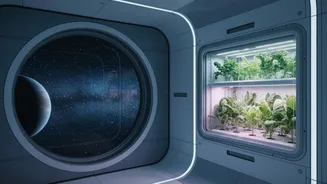
While significant progress has been made on air and water, the two most challenging parts of closing the loop remain food and solid waste. Currently, all astronaut food is brought from Earth. For a Mars mission, this would require an enormous amount of mass and volume. The solution is to grow it. Experiments like the Veggie and Advanced Plant Habitat on the ISS have demonstrated that it's possible to grow leafy greens and other vegetables in microgravity. This not only provides a source of fresh food and psychological benefits for the crew, but the plants also contribute to air revitalization by converting carbon dioxide into oxygen. The final piece of the puzzle is dealing with waste—everything from human waste to food scraps and packaging. Truly closing the loop will require technologies that can efficiently convert these waste products back into useful resources, such as water or nutrients for plants.
From the Red Planet to Earth
The push for closed-loop systems is not just about exploring other worlds; it has profound implications for our own. The technologies being developed to purify water with extreme efficiency, manage waste, and grow food with minimal resources are directly applicable to sustainability challenges on Earth. Innovations in water filtration designed for astronauts can be adapted for use in remote communities or disaster-stricken areas. The principles of ultra-efficient, small-scale agriculture could inform vertical farming and urban food production. In solving the problems of living in a harsh, resource-scarce environment like space, we are simultaneously developing solutions for living more sustainably on our home planet.