



The Growing Danger in Earth's Orbit
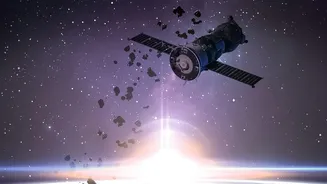
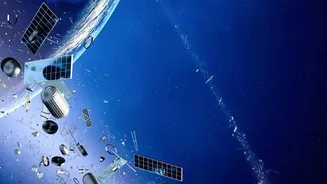
Think of the space above our planet as an increasingly busy highway, but with no traffic lights and lanes filled with speeding bullets. Right now, thousands of active satellites share their orbits with millions of pieces of space junk—defunct satellites,
discarded rocket stages, and fragments from past collisions. These objects travel at incredible speeds, around 27,000 km/h in Low Earth Orbit (LEO). At that velocity, a collision with an object even a centimetre wide can be catastrophic, destroying a multi-crore satellite and creating thousands of new pieces of dangerous debris. For a space-faring nation like India, which relies on its satellites for communication, weather forecasting, disaster management, and national security, this is a serious threat. Protecting these assets is no longer optional; it's a critical necessity.
India's Proactive Approach to Space Safety
The Indian Space Research Organisation (ISRO) is tackling this problem head-on. The agency has been performing an increasing number of Collision Avoidance Manoeuvres (CAMs) each year, physically moving its satellites out of harm's way. In 2025 alone, ISRO conducted a record 140 such manoeuvres to protect its assets. These operations, however, consume precious fuel, which can shorten a satellite's operational lifespan. Recognizing the growing challenge, India has announced an ambitious goal: Debris Free Space Missions by 2030, aiming for zero new debris from any Indian space activity. A key part of this strategy involves building smarter, more autonomous satellites that can protect themselves. This is where artificial intelligence comes in.
Enter the AI-Powered Smart Shield
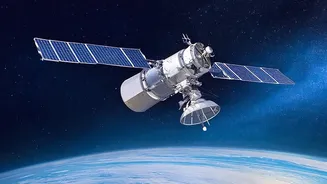
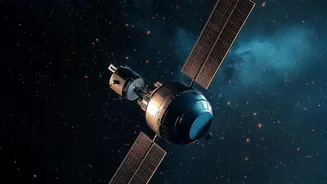
The next generation of Indian satellites, particularly Earth-observation spacecraft, are being designed with a revolutionary capability: autonomous collision avoidance. Instead of relying solely on commands from ground control, these satellites will use onboard AI to detect threats and make decisions independently. In collaboration with academic institutions like IIIT-Delhi, ISRO is developing a sophisticated AI-powered Space Situational Awareness (SSA) platform. This system processes vast amounts of data from ground-based trackers and onboard sensors to predict potential collisions with far greater speed and accuracy than human operators. When a threat is identified, the AI calculates the optimal escape path and automatically triggers the satellite's propulsion system to execute the manoeuvre. This ability is crucial, especially in situations where communication with ground stations might be delayed or impossible.
The Role of Advanced Electric Thrusters
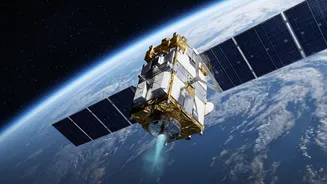
Executing these autonomous manoeuvres requires a new kind of engine. Traditional chemical thrusters provide powerful bursts but are heavy and consume a lot of fuel. The solution lies in advanced electric propulsion systems, like Hall-effect thrusters. These thrusters use electric and magnetic fields to ionize and accelerate a propellant gas, creating a gentle but highly efficient thrust. Bengaluru-based startup Bellatrix Aerospace is a key player in this field, developing Hall thrusters that are ideal for the precise, frequent adjustments needed for collision avoidance and station-keeping. These electric thrusters use significantly less fuel, allowing a satellite to perform many more manoeuvres and extending its life in orbit. This synergy between onboard AI and efficient electric propulsion forms the core of India's autonomous defence system for its satellites.
Why This Is a Game-Changer for India
This leap into autonomous systems is a massive step forward for India's space program. It ensures the safety and longevity of high-value national assets like the fleet of Earth-observation satellites that provide critical data for everything from agriculture to urban planning. It reduces the immense workload on ISRO's tracking and control teams, allowing them to focus on broader mission objectives. Furthermore, by pioneering responsible space operations and debris mitigation, India solidifies its reputation as a leading and conscientious global space power. This technology is not just about defence; it's about enabling a sustainable future in space, ensuring that the final frontier remains open for exploration and utilisation for generations to come.