


The Life and Death of a Star
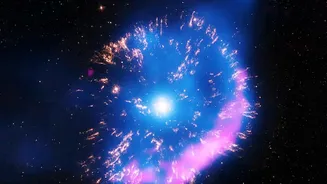
Most stars, including our own Sun, have a predictable life cycle. For billions of years, they fuse hydrogen into helium, creating light and heat. But when that fuel runs low, they swell into enormous 'red giants'. This phase is catastrophic for any nearby
planets; in our solar system, Mercury and Venus will almost certainly be engulfed. Earth's fate is less certain, but it would be rendered uninhabitable. After this violent expansion, the star sheds its outer layers and collapses into an incredibly dense, Earth-sized core called a white dwarf—a stellar remnant that slowly cools over billions of years.
An Unexpected Signal
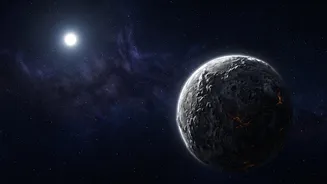
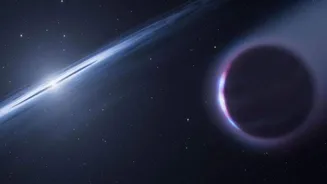
Planets aren't supposed to survive this process intact, especially not close to the star. Yet, astronomers have been puzzled by strange signals from these stellar relics. The recent focus is on a white dwarf named HS 0209+0832, located about 270 light-years away. Using data from NASA's TESS satellite, researchers detected a faint, repeating dip in the star's brightness every 4.4 days. This kind of regular dimming is often a tell-tale sign of an orbiting object, in this case, a potential planet candidate about the size of Jupiter.
Clues in the Stardust
What makes this discovery truly remarkable isn't just the signal, but the white dwarf's strange chemical composition. By re-analysing 25-year-old data from the Hubble Space Telescope, a team led by researchers from the University of Warwick made a breakthrough. The atmosphere of HS 0209+0832 contained high amounts of elements like zinc, copper, and most notably, niobium. Niobium was found at levels over 1,000 times higher than in our Sun and had never been reported in a white dwarf before. These heavy elements are forged inside dying stars, not in the initial cloud of gas that forms first-generation planets like Earth.
A Planet Born From Ashes
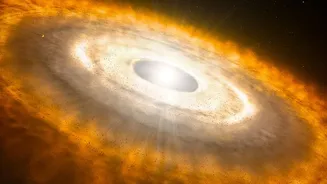
This chemical fingerprint points to a fascinating origin story. The planet candidate likely didn't survive the star's death—it was born from it. This is the theory of a 'second-generation' planet. As the star died, it would have shed its outer layers, which are rich in newly created heavy elements. Over time, this debris could have formed a new disk around the white dwarf, from which a new planet coalesced. The intense heat from the young, hot white dwarf is likely boiling off the planet's atmosphere, causing a stream of material containing niobium and other elements to rain down onto the star's surface, which is how Hubble was able to detect them.
Rewriting the Rules of Planet Formation
The existence of a second-generation planet would be a game-changer for astronomy. It suggests that stellar systems can have a 'second act'. While planets born from stellar death have been suspected around pulsars (the remnants of much more massive stars), finding one around a common white dwarf was unexpected. It implies that the end of a star's life isn't necessarily the end for planetary systems. Instead, it can be the start of a new, albeit different, chapter of creation. The lead author of the study, Jamie Williams, noted that this research points to a much longer tale, with new characters showing up after the first act is over.