


A New Star Ignites the Sky
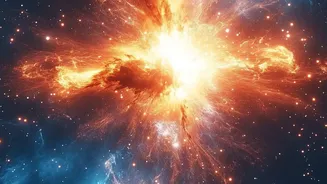
Imagine looking up at the night sky and seeing a star that wasn't there before, one that quickly becomes brighter than any other star or planet. That's what happened in early October 1604, when observers across Europe, China, and Korea noticed a 'guest
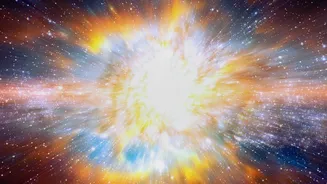
star' in the constellation Ophiuchus, the serpent-bearer. This event, now known as SN 1604 or Kepler's Supernova, was a spectacular cosmic explosion. At its peak, it shone with an apparent magnitude of -2.5, outshining Jupiter and remaining visible during the day for over three weeks before eventually fading from sight after about 18 months. Its appearance was a global event, with meticulous records kept not just in Europe, but also in Asia, providing invaluable data for future astronomers.
The Pre-Telescope Toolkit
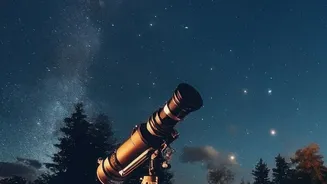
The supernova of 1604 appeared just four years before the telescope was first turned to the sky by Galileo Galilei. So, how did astronomers study it with such precision? They relied on a suite of sophisticated naked-eye instruments. The primary tools were the quadrant, a 90-degree arched instrument, and the sextant, a 60-degree version, which were used to measure the angular positions of celestial objects with remarkable accuracy. Another tool was the armillary sphere, a model of the celestial sphere used to measure the coordinates of stars. To determine the supernova's position, observers would use these instruments to carefully measure its angular distance from known, fixed stars in the same part of the sky. Brightness was estimated by direct comparison to nearby planets like Mars and Jupiter, and other bright stars.
Kepler's Methodical Investigation
Though he wasn't the first to see it, the supernova is named after German astronomer Johannes Kepler because of his extensive study, which he published in his 1606 book, 'De Stella Nova' ('On the New Star'). Kepler, working in Prague, meticulously compiled his own observations with those of other European astronomers. His most crucial measurement, or lack thereof, was of parallax—the apparent shift in an object's position when viewed from two different locations. Observers across Europe saw the star in the same position relative to the background stars. This lack of observable parallax proved the 'new star' was not a phenomenon in Earth's atmosphere or even nearby like the Moon. Kepler concluded it must be in the realm of the 'fixed stars', a direct challenge to the Aristotelian idea that the heavens were perfect and unchanging.
A Global Effort
While Kepler's analysis was groundbreaking, European astronomers were not the only ones documenting the event. In fact, Chinese observers noted the star a day after its first sighting in Europe, and Korean royal astronomers began their observations on October 13, 1604. The records from Korea's Joseon Dynasty are considered some of the most detailed, with continuous observations recorded for months. These non-European records, which referred to the event as a 'guest star', have been vital for modern astronomers to reconstruct the supernova's light curve—how its brightness changed over time. This global effort highlights a shared human curiosity about the cosmos, with different cultures contributing crucial pieces to the scientific puzzle.
The Dawn of a New Astronomy
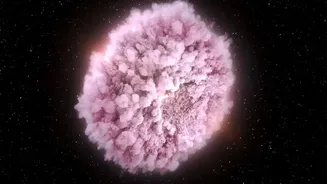
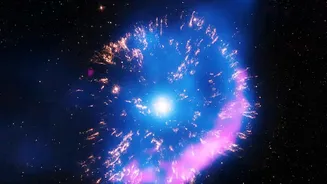
The supernova of 1604, along with one observed by Tycho Brahe in 1572, delivered a powerful blow to the long-held geocentric model of the universe, which held that the heavens were immutable. These events showed that the stars could, in fact, change. While observers at the time thought they were seeing the birth of a star, we now know they were witnessing a spectacular stellar death—a Type Ia supernova, caused by the explosion of a white dwarf star in a binary system. The intellectual ferment caused by SN 1604 helped set the stage for the astronomical revolution that would follow. When Galileo pointed his telescope at the sky a few years later, his discoveries of Jupiter's moons and the phases of Venus provided the final nails in the coffin for the old cosmology, a shift that Kepler's star had helped to start.