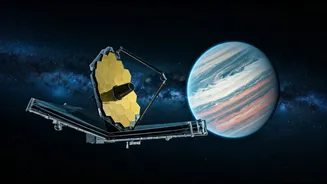









The Cosmic Rollercoaster
Located about 217 light-years away in the constellation Ursa Major, HD 80606 b is a gas giant about four times more massive than Jupiter. It was first discovered in 2001, but what makes it stand out is its incredibly eccentric, comet-like orbit. Instead
of a gentle, predictable loop, this planet embarks on a 111-day journey that is pure chaos. For most of its year, it travels far out from its star, to a distance comparable to that between Venus or Earth and our Sun. Then, in a final, frantic plunge, it sweeps perilously close to its star—much closer than Mercury is to the Sun—in a matter of hours before being flung back out into the cold.
A World of Whiplash
This extreme orbit creates some of the most violent weather imaginable. As HD 80606 b makes its closest approach, the amount of energy it receives from its star increases by more than 800 times. Observations from NASA's Spitzer and James Webb Space Telescopes have measured the consequences of this stellar flash-heating. In just six hours, the temperature on the planet's star-facing side skyrockets from a relatively cool 527 degrees Celsius to a blistering 1,230 degrees Celsius. This sudden, intense heating is so powerful that if Earth were subjected to it, our atmosphere would be stripped away and the surface would turn to molten rock.
Storms Beyond Imagination
The rapid temperature change doesn't just heat the planet; it triggers colossal, planet-wide shockwaves. Computer models based on the telescope data predict that this energy blast creates enormous storm systems with winds raging at over 17,000 kilometres per hour. These are not just storms; they are atmospheric explosions that ripple from the superheated day side to the cooler night side. This was the first time astronomers detected weather changes happening in real-time on a planet outside our solar system, making HD 80606 b a crucial laboratory for understanding atmospheric physics under the most extreme conditions.
A Puzzle for Planet Formation
HD 80606 b belongs to a class of exoplanets known as "hot Jupiters," massive gas giants orbiting close to their stars. But its wild orbit challenges the leading theories on how these planets form and migrate. Scientists believe these giants form far from their stars and are then pushed into closer orbits over millions of years, a process that should circularize their path. However, HD 80606 b seems to be resisting this circularization, suggesting it may remain on its eccentric path for billions of years. One theory is that its orbit is the result of the gravitational influence of a companion star in its system, a mechanism known as the Kozai effect. Studying this planet helps refine the technological models and business cases for future observation missions, as each new piece of data provides a massive return on investment in our understanding of the universe.