





Sailing on a Sea of Starlight
The concept of a solar sail sounds like something out of science fiction, but it's a very real and increasingly successful technology. At its core, a solar sail is a large, ultra-thin, mirror-like sheet deployed in space. Instead of catching wind, it catches
sunlight. This isn't about using solar panels to generate electricity; it's about using the physical pressure of light itself to push a spacecraft. This pressure comes from particles of light called photons. While photons have no mass, they do have momentum. When a countless stream of photons from the Sun strikes the reflective surface of a solar sail, they transfer their momentum, giving the craft a tiny, but constant, push. In the frictionless vacuum of space, this gentle, continuous thrust adds up, allowing a spacecraft to accelerate constantly and reach immense speeds over time, far beyond what could be achieved with conventional chemical rockets that carry a limited fuel supply.
The ACS3 Mission: A Major Leap Forward
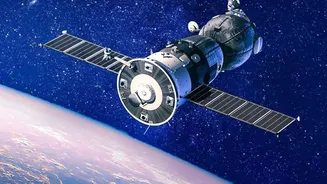
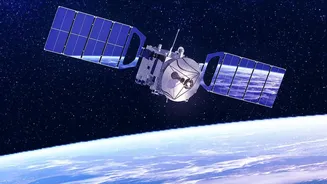
The latest breakthrough in this field comes from NASA's Advanced Composite Solar Sail System, or ACS3. Launched aboard a Rocket Lab Electron vehicle, this mission is designed to test critical new technologies that make solar sails bigger, lighter, and more effective. The primary goal was to successfully deploy new, lightweight booms made of a flexible polymer and carbon fiber materials. These booms, which provide the sail's structure like a mast on a ship, are 75% lighter than previous designs. In late August 2024, NASA confirmed that the ACS3 spacecraft, which is roughly the size of a microwave oven, successfully unfurled its sail to its full size of about 80 square meters, or nearly half a tennis court. This successful deployment of the innovative lightweight booms is a crucial step, proving the technology can work in space and paving the way for much larger and more powerful sails in the future.
Navigating the Cosmos
Beyond simply deploying the sail, the ACS3 mission aims to demonstrate that it can actively navigate. Just as a sailboat tacks to change direction against the wind, a solar sail can change its angle relative to the Sun. By tilting the sail, mission controllers can alter the direction of the gentle push from sunlight, allowing them to steer the spacecraft and change its orbit. The ACS3 team is now observing the spacecraft's ability to perform these maneuvers. Although the spacecraft entered a slow tumble after deployment, which was expected, the team is working to re-engage its attitude control systems to begin the sailing tests. Data gathered from these navigational tests will be critical for designing future missions that can journey to asteroids, observe the polar regions of the Sun, or act as early-warning satellites for space weather.
The Future is Fuel-Free
The success of missions like ACS3, and The Planetary Society's LightSail 2 before it, marks a turning point for space exploration. The primary advantage of solar sails is the elimination of heavy, expensive, and finite propellant. This not only lowers the cost of missions but also enables long-duration voyages that are currently impractical. With constant acceleration, solar sail-powered probes could reach the outer planets in months instead of years. Some concepts even propose using a close flyby of the Sun as a 'slingshot' maneuver, which could propel a lightweight craft to near-relativistic speeds, potentially reaching interstellar space within just a few years. This technology could enable missions that were once thought to be decades away, from detailed reconnaissance of small bodies in our solar system to sending the first probes to other star systems.