







What is Seasonal Living?
At its heart, seasonal living is the practice of aligning your lifestyle—your diet, activities, energy levels, and even your goals—with the patterns of the year. It’s a concept that goes far beyond simply eating strawberries in summer or pumpkin in autumn.
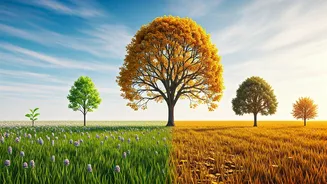
Think of it as a philosophical shift. Instead of pushing for peak productivity and social engagement all year round, you honour the distinct energy of each season. Winter becomes a time for rest, reflection, and quietude. Spring is for planning, planting seeds for new ideas, and gentle emergence. Summer is for vibrant social connection, action, and celebration. Autumn is for harvesting the fruits of your labour, taking stock, and gracefully letting go of what no longer serves you.
A Gentle Cure for Modern Burnout
So, why is this idea resonating so strongly right now? The answer lies in the problem it aims to solve: chronic burnout. Modern life, with its constant digital pings, demanding work culture, and the pressure to be perpetually 'on', operates like an endless, artificial summer. We're expected to be productive, sociable, and energetic every single day, regardless of how we actually feel. This disconnect from our natural internal rhythms, and those of the world around us, is exhausting. Seasonal living offers a powerful antidote. It grants permission to slow down, to be less 'productive' in winter without guilt, and to embrace bursts of energy in summer without feeling like it must be sustained forever. It reframes rest not as a failure or a luxury, but as a necessary and productive part of a cycle.
The Wisdom of Ancient Rhythms
While it might feel like a new wellness trend popularised on social media, the concept is ancient. For millennia, human life was intrinsically tied to the seasons out of necessity. Agriculture, festivals, and community life all revolved around the solar calendar. Many traditional wisdom systems, like Ayurveda in India and Traditional Chinese Medicine, are built on the principle of living in harmony with seasonal changes to maintain physical and mental balance. For instance, Ayurveda suggests eating cooling foods in the summer to pacify 'pitta' (the fire element) and warm, nourishing foods in the winter to balance 'vata' (the air and space element). By embracing seasonal living, many people feel they are tapping into a deeper, more intuitive wisdom that our modern lifestyles have caused us to forget.
How a Seasonal Life Looks
In practice, this doesn't require a radical life overhaul. It’s about small, intentional shifts. A 'wintering' mindset, as popularised by author Katherine May, might mean saying no to more social invitations, prioritising sleep, and engaging in cosy, indoor hobbies. A 'spring' life could involve decluttering your home, starting a new fitness routine, or brainstorming creative projects. Summer is the natural time for travel, late-night gatherings with friends, and tackling ambitious projects that require high energy. In autumn, you might focus on finishing tasks, preserving food (whether literally by canning or figuratively by documenting your achievements), and creating a comfortable space to prepare for the coming winter. The focus is always on working with your energy, not against it.