



The Ultimate Recycling Challenge
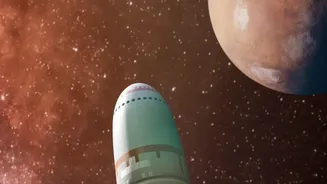
Imagine living in a sealed box for three years with everything you will ever have. That's the reality of a mission to Mars. A closed-loop resource management system is designed to solve this by creating a miniature, artificial ecosystem. Unlike on Earth,
where resources seem limitless, or even on the International Space Station (ISS), which gets regular supply shipments, a deep-space mission must be almost completely self-sufficient. These systems aim to recycle nearly 100% of all air, water, and waste, turning the outputs of human life—breath, sweat, urine, and faeces—back into essential inputs like clean water, breathable air, and even food.
The Tyranny of Mass
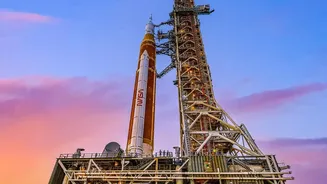
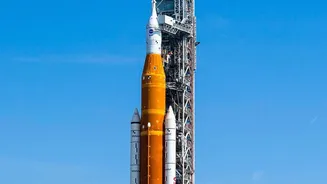
The core problem is simple: launching anything into space is extraordinarily expensive and difficult. According to NASA, a four-person crew on a three-year Mars mission would require over 10,000 kilograms of food alone. Add to that the water for drinking, hygiene, and oxygen production, and the total mass becomes staggering. Launching that much material is not just financially prohibitive; it's a logistical nightmare. Estimates for landing a single metric ton of cargo on Mars run as high as $100 million. Recycling isn’t just an environmental goal in space; it’s the only way to make the mission mathematically and economically viable. Without it, the weight of supplies would make the spacecraft too heavy to launch.
From Wastewater to Drinking Water
The most mature part of closed-loop technology is water and air recycling, which is already in practice on the ISS. The station's Environmental Control and Life Support System (ECLSS) captures moisture from the crew's breath and sweat, as well as wastewater and urine. This collected liquid is then put through a sophisticated multi-step purification process involving filters, catalytic reactors, and distillation. The result is water that is often purer than what most people drink on Earth. NASA recently celebrated achieving a 98% water recovery rate on the ISS, a critical milestone that proves the concept for long-duration missions where every drop is precious.
Breathing Life Back into the Air
Similarly, the air astronauts breathe is constantly scrubbed and regenerated. Systems on the ISS remove the carbon dioxide (CO2) that crew members exhale. Through a chemical process known as the Sabatier reaction, this captured CO2 is combined with hydrogen to produce water and methane. The water can then be split through electrolysis to produce breathable oxygen, with the hydrogen being reused in the cycle. This not only replenishes the oxygen supply but also reduces the amount of water that needs to be brought from Earth for this purpose, further closing the loop.
The Final Frontier: Food and Waste
The biggest remaining challenge is food production and the processing of solid organic waste. While astronauts can't yet grow all their own food, significant progress has been made. Experiments on the ISS, like the 'Veggie' project, have successfully grown lettuce, peppers, and tomatoes in microgravity. The long-term vision is to create bioregenerative systems where plants not only provide food but also contribute to air revitalization and water purification, just as they do on Earth. Researchers are developing technologies to process human and food waste into nutrients for these space-based farms, aiming to one day fully close the resource loop and turn a sterile spacecraft into a living, sustainable habitat.