





Preparing for Your Celestial Tour
The first step to a successful stargazing night is preparation. The most important factor is finding a dark location, away from the glow of city lights. For those in or near major Indian cities like Mumbai, Delhi, or Bengaluru, this can mean a short drive
to escape the worst of the light pollution. Locations like the Western Ghats near Coorg, the Sahyadri ranges outside Mumbai, or the outskirts of Pune can offer significantly darker skies. Check a light pollution map online before you go. Next, give your eyes at least 15-20 minutes to fully adapt to the darkness. Avoid looking at your bright phone screen; use a red-light torch if you need to see, as it won't spoil your night vision. Finally, dress in warm layers. Autumn nights can get surprisingly chilly, even if the day was warm.
What Kind of Binoculars Do You Need?
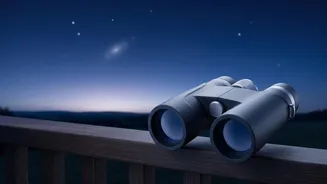
You might already own the perfect tool for your celestial journey. A standard pair of binoculars, such as 7x50 or 10x50 models, is ideal for beginners. The first number refers to the magnification (7x or 10x), and the second is the diameter of the main lenses in millimetres. A 50mm lens is great for gathering the faint light from distant objects. While more expensive, image-stabilised binoculars can make viewing easier by compensating for the natural shaking of your hands, but they aren't essential. To get a steadier view with any pair, try bracing yourself against a wall or car, or mounting the binoculars on a simple tripod.
Your Main Target: The Andromeda Galaxy (M31)
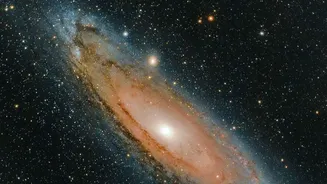
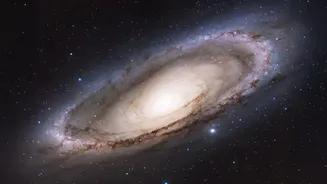
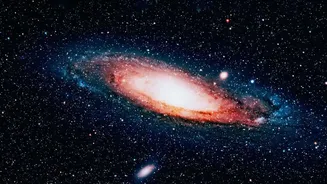
The Andromeda Galaxy is the most distant object you can see with the naked eye, but it truly comes to life through binoculars. It's a spiral galaxy much like our own Milky Way, located about 2.5 million light-years away. To find it, first locate the W-shaped constellation of Cassiopeia, which is prominent in the autumn sky. Another signpost is the Great Square of Pegasus. The Andromeda Galaxy is situated between these two constellations. Under a dark sky, it will appear as a faint, fuzzy, oval-shaped smudge of light. Don't expect to see spiral arms; what you are witnessing is the combined light of over a trillion stars. The bright central core is usually the easiest part to spot. Seeing this 'island universe' with your own eyes is an unforgettable experience.
A Dance of Moons: Jupiter and its Satellites
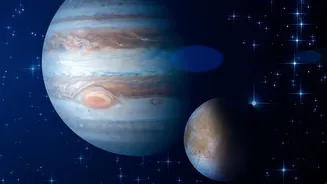
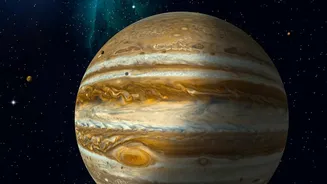
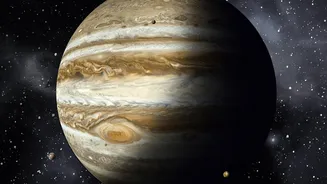
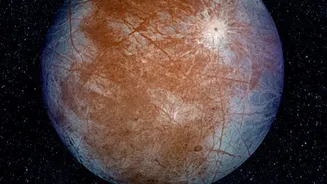
Jupiter, the king of the planets, is a brilliant, star-like object in the night sky that stands out because, unlike stars, it doesn't twinkle. It is often one of the brightest points of light. When you aim your binoculars at Jupiter, you will resolve it from a point of light into a tiny, distinct disk. The real magic lies next to it: a straight line of up to four tiny pinpricks of light. These are the Galilean moons, discovered by Galileo in 1610: Io, Europa, Ganymede, and Callisto. On any given night, you might see all four, or you might see only two or three if one is behind or in front of the planet. Observing them from one night to the next reveals their constant dance as they orbit the giant planet, a miniature solar system visible right from your backyard.
Other Autumn Sky Highlights
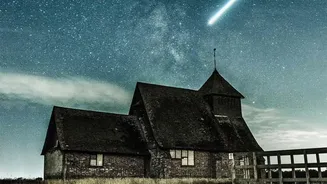
Once you've found Andromeda and Jupiter, there's more to see. Scan the sky for the Pleiades star cluster, also known as the Seven Sisters. While visible to the naked eye as a tiny, dipper-shaped group of stars, binoculars reveal dozens more stars sparkling like a handful of scattered diamonds. Autumn is also a great time to see meteor showers like the Orionids in October or the Geminids in December. While you don't need binoculars for meteors, finding a dark sky to spot the main attractions will put you in the perfect place to catch these shooting stars as a bonus.