




First, What Is a 'Day' and a 'Year'?
Before we dive into the Venusian paradox, let's get our terms straight. For any planet, a 'year' is the time it takes to complete one full orbit around its star. For Earth, that’s roughly 365 days. A 'day' is the time it takes for the planet to complete one full rotation
on its own axis. For Earth, that’s about 24 hours. These two motions—orbiting and spinning—are completely independent of each other. They dictate the fundamental rhythm of a planet's existence: the cycle of seasons and the cycle of day and night. On Earth, we are accustomed to a system where we experience hundreds of days within a single year. Venus, however, throws this familiar logic completely out the window.
The Venusian Calendar By the Numbers
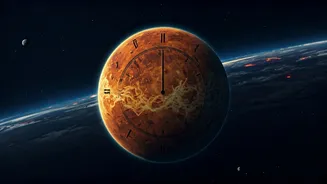
Here's where the mind-bending reality kicks in. A year on Venus—the time it takes to orbit the Sun—is approximately 225 Earth days. This is its 'orbital period.' Now, for the day. A single day on Venus—the time it takes to complete one rotation on its axis—is approximately 243 Earth days. Yes, you read that correctly. It takes Venus 243 Earth days to spin around just once, but only 225 Earth days to travel all the way around the Sun. A Venusian day is therefore about 18 Earth days longer than a Venusian year. If you were standing on Venus, the planet would complete its entire yearly journey around the Sun before a single 'day' (one full rotation) had even finished. You would celebrate your first birthday on Venus before you’d even experienced a full day-night cycle in this rotational sense.
The Secret: A Slow, Backward Spin
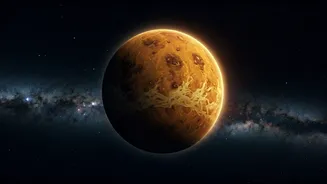
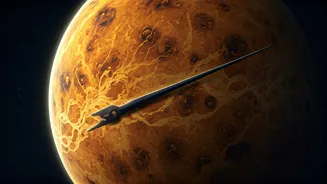
So, what causes this bizarre temporal mismatch? The answer lies in Venus's rotation. It is incredibly, astonishingly slow. But it's not just slow; it's also backward. Most planets in our solar system, including Earth, spin counter-clockwise on their axis, a direction known as 'prograde' motion. Venus, along with Uranus, is an exception. It spins clockwise, a motion known as 'retrograde' rotation. This slow, backward spin is the key to everything. While other planets spin rapidly, creating many short days within their yearly orbit, Venus lazily turns in the opposite direction. This lethargic rotation is so extreme that its spinning period has ended up being longer than its orbital period.
A Tale of Two Venusian Days
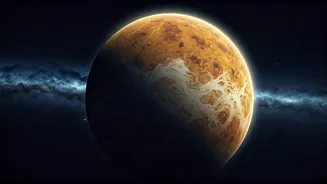
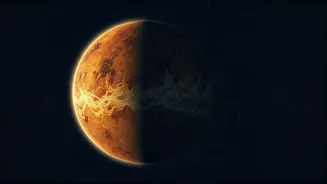
To add another layer of strangeness, the backward rotation creates a difference between two types of 'day'. The 243-day figure is the 'sidereal day'—the time it takes to rotate once relative to the distant stars. However, a 'solar day'—the time from one sunrise to the next—is different. Because Venus is rotating backward while orbiting the Sun, a sunrise-to-sunrise cycle is much shorter. A solar day on Venus is about 117 Earth days long. This is still an incredibly long time to wait for the sun to rise again, but it means you'd experience roughly two sunrises and sunsets in a single Venusian year. It's a cosmic oddity where your 'day' is defined by which reference point you use: the stars or the Sun.
Why Is Venus So Weird?
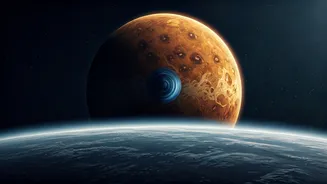
Scientists don't have a definitive answer for why Venus spins so slowly and backward, but there are two leading theories. One hypothesis suggests that early in its history, Venus was struck by a massive asteroid or another planet-sized object. Such a colossal impact could have been powerful enough to reverse its original direction of spin and slow it down dramatically. The other prominent theory involves Venus's incredibly thick and heavy atmosphere. This dense blanket of carbon dioxide, about 90 times thicker than Earth's, creates an intense greenhouse effect and exerts immense pressure on the surface. Some models suggest that atmospheric friction and tidal forces created by this thick atmosphere could have acted like a brake over billions of years, gradually slowing the planet's rotation to its current crawl and possibly even flipping it over.