





Artificial Intelligence is rapidly changing how we work, but are our workplaces keeping up? A new report from Colliers highlights a critical disconnect between what companies expect from AI and how they are preparing their offices for this new reality.
The Great Disconnect
The central finding of the recent Colliers report, 'Asia Pacific Workplace Insights: Forces shaping office decisions in 2027', is a startling gap between strategy and execution. While virtually all business leaders surveyed expect AI to fundamentally reshape their workforce, a majority have not translated these expectations into their real estate and workplace strategies. The report reveals that while 100% of companies expect AI to create new, specialised roles, 57% have not aligned these anticipated workforce changes with their upcoming lease decisions. In essence, companies know a massive shift is coming, but their physical footprints are still stuck in the past. The biggest risk, the report suggests, is not AI itself, but failing to plan for its impact on physical space.
Human Capital, Not Footprint Reduction
Interestingly, especially in high-growth regions like India and Southeast Asia, the focus of AI integration is squarely on human capital. According to the Colliers survey, over 40% of leaders in this region rank the creation of new AI-driven roles, skills, and collaboration methods as a top priority. This has led to strong demand for different types of office spaces (50%), while simply reducing the overall office footprint is a low priority (7%). Businesses anticipate AI will lead to fewer traditional roles but greater overall productivity (85% of respondents) and an increase in project-based, cross-functional teams (62%). This suggests a move away from seeing the office as just a place for individual tasks and toward a hub for high-value collaboration and innovation.
Why Workplace Strategy Is Lagging
If the need for change is so clear, why the lag in real estate decisions? A related report from Colliers and CoreNet Global identifies several barriers. While AI is cited as the single biggest driver of change in corporate real estate, innovation is being hampered. About half of all respondents felt only 'somewhat ready' to innovate, with just 21% having a well-defined framework to do so. The primary culprits are familiar business challenges: financial constraints, limited time and capacity, and general organisational resistance to change. This creates a scenario where the tech and HR departments are racing ahead with AI implementation, while the corporate real estate strategy that should support them is left playing catch-up.
The Office of the Future
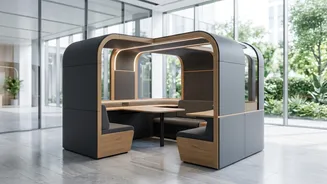
So what should the AI-ready workplace look like? The consensus is that it needs to be more human, not less. As AI and automation handle more routine and mundane tasks, the physical office must evolve to support what technology cannot replicate: deep collaboration, creativity, and building a strong company culture. This means a shift away from seas of uniform desks toward more dynamic, flexible, and activity-based environments. Companies will need to reconfigure their spaces to support the project-based teams and new specialised roles that AI will create. Instead of being a place where work is simply done, the office will become a strategic asset for attracting talent and driving the highlevel innovation that keeps a business competitive.
Bridging the Gap: From Awareness to Action
Closing the disconnect requires a proactive, integrated approach. Colliers advises that organisations must start turning opportunity into execution. The first step is to move beyond simply acknowledging AI's impact and begin actively testing AI use cases and building a strategic roadmap. This involves aligning portfolio, workplace, and data strategies to get a clearer picture of how space is actually being used and what future needs will be. Furthermore, organisations must invest in upskilling their teams to manage this transition. For many companies, the focus remains on optimising for productivity and innovation, but this can't happen without a framework for measuring workplace effectiveness—something a quarter of firms still lack. In the end, the companies that thrive will be those that see their real estate not as a static cost, but as a dynamic platform for human potential.