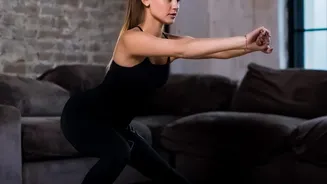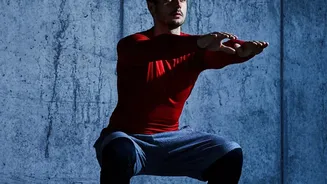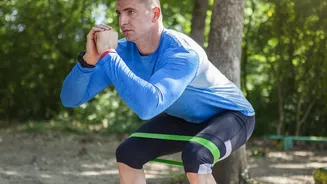




The walking lunge is a powerhouse exercise, blending strength training with dynamic movement. Unlike its stationary cousin, it challenges your body to travel forward, supercharging benefits for balance, coordination, and real-world strength.
What is a Walking Lunge?
A walking
lunge is a dynamic variation of the basic lunge exercise. Instead of pushing back to a standing position after each repetition, you propel your body forward by bringing your back leg through to begin the next lunge. This continuous forward motion transforms a simple strength move into a compound exercise that enhances coordination, stability, and cardiovascular conditioning alongside muscle building. It closely mimics natural movements like walking up a hill or climbing stairs, making it a highly functional exercise that translates directly to everyday life. Because you are constantly moving and re-balancing with each step, it engages more stabilizing muscles and elevates your heart rate more than a static lunge does.
Mastering the Form: A Step-by-Step Guide
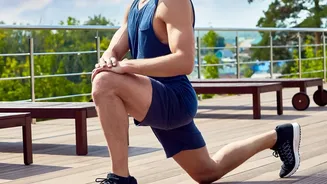
Proper form is crucial to maximise benefits and prevent injury. Start by standing tall with your feet hip-width apart and your core engaged. 1. Take a controlled step forward with your right leg, about two to three feet. Your stride should be long enough that you can comfortably create 90-degree angles with both knees as you lower your body. 2. Bend both knees and descend until your right thigh is parallel to the floor and your left knee hovers just above it. Your front shin should be vertical, and your front knee should be aligned over your ankle, not drifting past your toes. 3. Keep your torso upright and your chest lifted throughout the movement. Avoid leaning forward or rounding your back. 4. Drive through your right heel to push your body upward and forward. Instead of returning to the start, swing your left leg through and step directly into the next lunge, planting your left foot in front. 5. Continue this walking pattern, alternating legs with each step, for a set distance or number of repetitions.
The Muscles You'll Target
Walking lunges are a comprehensive lower-body workout, engaging multiple muscle groups with every step. The primary movers are the large muscles of your legs. Your quadriceps, the muscles on the front of your thighs, work to extend the knee as you push off the ground. The gluteus maximus, your largest glute muscle, is heavily recruited to extend the hip as you rise from the lunge. Meanwhile, your hamstrings assist with hip extension and play a key role in stabilizing the knee joint. Beyond these main players, walking lunges call on a host of secondary and stabilizing muscles. Your calves (gastrocnemius and soleus) help with the final push-off. Crucially, your core muscles—including the abdominals and obliques—work hard to keep your torso upright and prevent twisting as you move. Your hip abductors, like the gluteus medius, are also fired up to stabilize your pelvis and prevent your hips from dropping to one side.
Key Benefits of Moving Forward
The forward momentum of walking lunges offers unique advantages over stationary variations. The primary benefit is the significant challenge to your balance and stability. Because you are briefly on a single leg while the other moves forward, your body must constantly adjust, which improves proprioception—your sense of where your body is in space. This dynamic balancing act builds functional strength that is essential for sports and reduces the risk of falls in daily activities. This exercise is also excellent for identifying and correcting muscle imbalances between your left and right sides. Since each leg works independently, a weaker side cannot be compensated for by a stronger one, forcing it to catch up. The constant movement also increases the cardiovascular demand, helping to burn more calories and improve your overall conditioning in a single, efficient exercise.
Common Mistakes to Avoid
To get the most out of your walking lunges, be mindful of these common form errors. Leaning the torso too far forward is a frequent mistake, often caused by a weak core or trying to use momentum. This shifts stress to your lower back instead of your glutes. To fix this, keep your chest up and look at a point a few feet in front of you. Allowing the front knee to collapse inward is another error, typically due to weak glute medius muscles. This puts undue stress on the knee joint. Focus on actively tracking your knee over your second toe. Taking a step that is too short or too long can also compromise the exercise. A step that is too short overloads the quads, while an overly long stride can strain the hamstrings and knee. Aim for a stance that allows both knees to bend to roughly 90 degrees. Finally, avoid pushing off your toes. Drive through the heel of your front foot to properly engage your glutes and hamstrings for a powerful and stable movement.