





A Steamy Atmosphere Far From Home
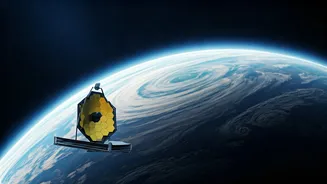
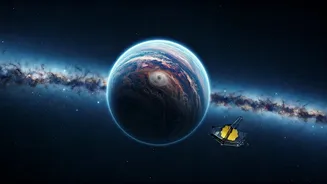
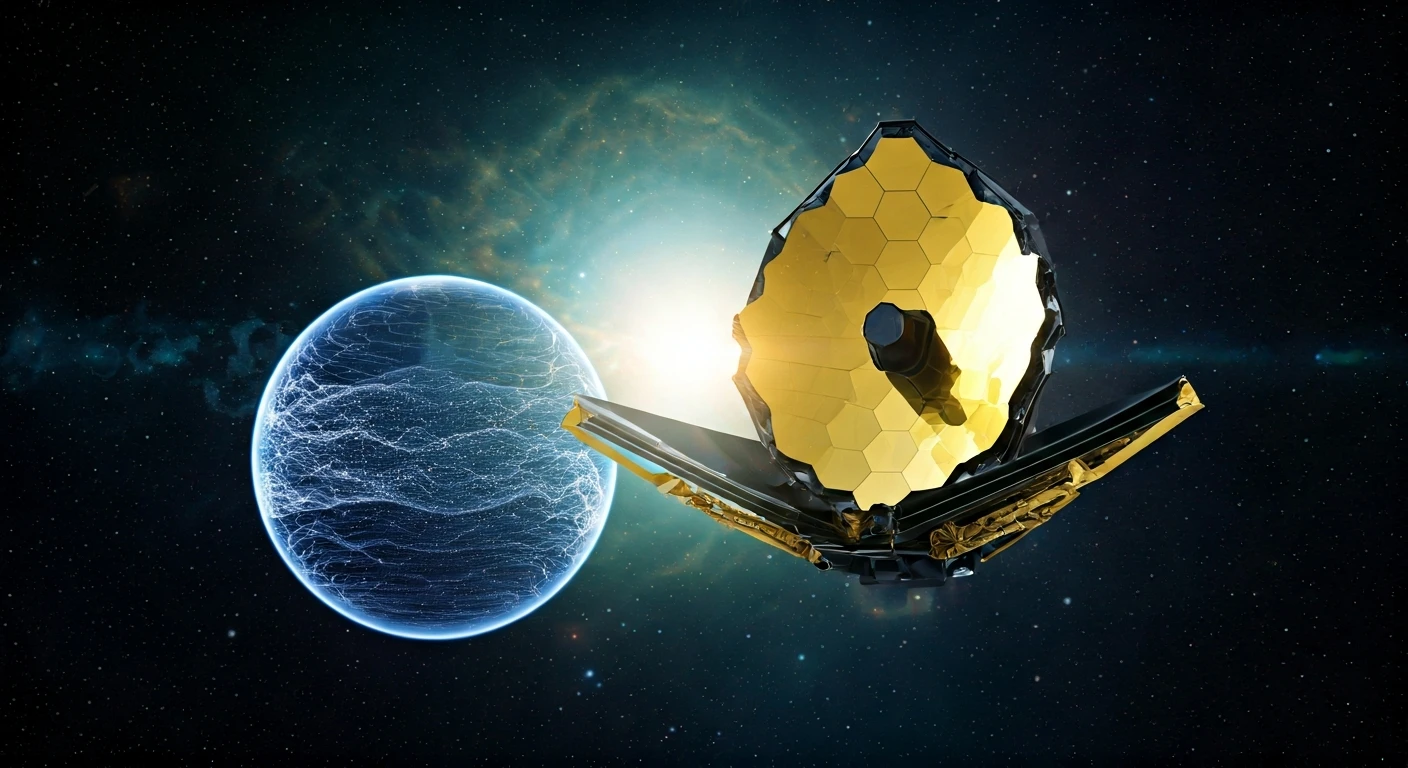
The latest breakthrough comes from a planet designated GJ 9827 d, located nearly 100 light-years from Earth. Using its powerful infrared instruments, the James Webb Space Telescope (JWST) detected a significant amount of water vapor, suggesting the planet is
enveloped in a hot, steamy atmosphere. This is not the first time Webb has found water in the cosmos, but the sheer quantity and the nature of this particular planet make it a significant find. Astronomers are calling it a potential 'steam world,' a type of planet completely unlike anything in our own solar system.
Meet a Mysterious 'Mini-Neptune'
GJ 9827 d is what's known as a 'mini-Neptune' or 'super-Earth,' a class of planets with a size somewhere between Earth and Neptune. These are among the most common types of planets found in our galaxy, yet we have no direct examples in our own cosmic neighbourhood, making them objects of intense scientific curiosity. This particular world is roughly twice the size of Earth. While hints of water were previously detected by the Hubble Space Telescope, JWST's superior technology was able to confirm that the atmosphere is rich with water vapor, providing an unprecedented look at this exotic world. However, with surface temperatures soaring to hundreds of degrees Celsius, this is not a world where one could expect to find liquid oceans.
How Webb Reads an Alien Sky
Detecting elements on a planet light-years away is a remarkable feat of engineering and science. The technique is called transmission spectroscopy. As GJ 9827 d passed in front of its host star from our perspective, the JWST carefully measured the starlight filtering through the planet’s atmosphere. Different molecules absorb light at specific wavelengths, creating a unique chemical fingerprint in the spectrum of light that reaches the telescope. By analysing which colours of light were missing, scientists could definitively identify the presence of water (H2O). This method allows astronomers to effectively 'read' the atmospheric composition of worlds that are far too distant to visit.
Water, But Not a Sign of Life
It is crucial to understand what this discovery means. Finding water vapor is a monumental step, but it does not mean the planet is habitable. GJ 9827 d orbits very close to its star, making its surface scorchingly hot—far too hot for life as we know it. Scientists are exploring two main possibilities for its origin. It could be a 'mini-Neptune' that formed farther from its star with a water-rich composition and migrated inward, or it might have been a larger gas giant that had its hydrogen and helium atmosphere stripped away by stellar radiation, leaving behind a dense, steamy remnant. Either scenario offers valuable clues into how planetary systems form and evolve.
The Ongoing Search for Another Earth
Every discovery by the JWST, from water-ice clouds on Jupiter-like planets to the steamy skies of GJ 9827 d, serves as a crucial piece of a much larger puzzle. These findings help scientists refine their models of planetary atmospheres and guide the search for planets that might have the right conditions for liquid water, a key ingredient for life. While some discoveries, like the potential for water on rocky planets like GJ 486 b, can be complex with signals that are hard to distinguish from the star itself, each observation pushes the boundaries of our knowledge. The ultimate goal remains finding an Earth-like planet with a stable atmosphere in the 'habitable zone'—the right distance from its star for liquid water to exist on its surface.