






Interstellar: A Journey Through Spacetime
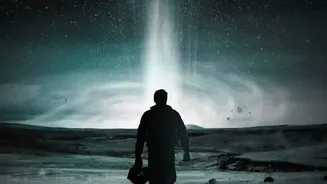
Christopher Nolan’s 2014 epic is more than a film; it's a theoretical physics lesson wrapped in a heart-wrenching family drama. What makes it a must-see on a large screen is its commitment to realism and scale. Working with physicist Kip Thorne, the visual
effects team rendered what is considered one of the most scientifically accurate depictions of a black hole in cinematic history. The sheer size of the celestial bodies, from the gargantuan waves on Miller's planet to the silent, terrifying beauty of Saturn's rings, is designed to dwarf the viewer. Much of the film was shot on IMAX cameras, meaning the picture expands to fill the entire screen, creating a truly immersive and overwhelming experience that a smaller screen simply cannot replicate. The scale is the point, and without it, you lose the awe.
Dune: Arrakis in Unrelenting Scale
Denis Villeneuve’s adaptation of Frank Herbert’s classic novel is a masterclass in world-building through sheer visual scale. The film's aesthetic is one of brutalist grandeur, where impossibly large spaceships land like ancient monoliths and the sandworms of Arrakis are forces of nature, not just monsters. Cinematographer Greig Fraser captures the desolate beauty of the desert planet with a palette that feels both alien and tangible. On a huge screen, the intricate details of the costume design, the vastness of the desert landscapes, and the sheer size of the machinery are breathtaking. You don't just see the Harkonnen invasion; you feel the weight of their oppressive architecture and the rumble of their spice harvesters. It’s a sensory overload in the best possible way, designed to make you feel like a tiny speck in a massive, unfolding history.
Gravity: The Terror and Wonder of Orbit
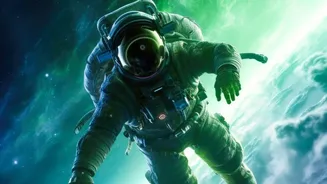
Alfonso Cuarón’s 2013 thriller is a testament to the power of minimalist storytelling amplified by groundbreaking visual effects. The film places you right inside the helmet of Dr. Ryan Stone, played by Sandra Bullock, as she is stranded in low Earth orbit. Its long, seamless takes and meticulously crafted CGI create a terrifyingly realistic depiction of the dangers of space debris and the silent void. A large screen enhances the feeling of both claustrophobia and agoraphobia. You feel trapped within the tight confines of a space suit while simultaneously being lost in the infinite blackness of space. The Earth hangs below like a beautiful, indifferent marble. This feeling of being untethered, of floating in a beautiful but deadly environment, is the core of the film’s tension and is best appreciated when the screen is big enough to dominate your field of vision.
Blade Runner 2049: A Dystopian Visual Poem
While not a space exploration film in the traditional sense, Denis Villeneuve's sequel to the 1982 classic creates one of the most visually stunning and coherent science fiction worlds ever put to film. Every frame, courtesy of legendary cinematographer Roger Deakins, is a work of art. The film transports you to a futuristic Los Angeles, bathed in neon and perpetual rain, and a desolate, orange-hued Las Vegas. The scale of the cityscapes, the holographic advertisements that loom over the streets, and the hauntingly empty landscapes are pure visual poetry. A huge screen allows you to drink in the details, from the texture of the light to the intricate production design in every corner of the frame. It’s a slow, contemplative film that uses its visuals to tell the story, and its full atmospheric power is unlocked when you let its world completely envelop you.
2001: A Space Odyssey: The Original Masterpiece
No list of visual spectacles is complete without Stanley Kubrick’s 1968 masterpiece. Long before the advent of modern CGI, Kubrick used pioneering practical effects, intricate models, and clever camera work to create a vision of space travel that still feels futuristic today. The film is famous for its long, quiet sequences set to classical music, like the iconic docking scene set to 'The Blue Danube'. These moments are designed to be meditative and hypnotic. On a large screen, the precision of the model work and the stark, clean lines of the spacecraft are fully appreciated. The 'Star Gate' sequence, a psychedelic journey through light and colour, becomes a truly mind-bending, immersive event. 2001 is not just a story; it’s a cinematic symphony that uses visuals to explore humanity’s place in the cosmos, and it demands the scale and focus that only a big screen can provide.