



SpaceX is preparing for its next ambitious Starship test, and its planned trajectory places the Indian subcontinent directly under its flight path. But what does a 'fly over' from the world's most powerful rocket actually mean?
What is Starship?
Starship is SpaceX's next-generation,
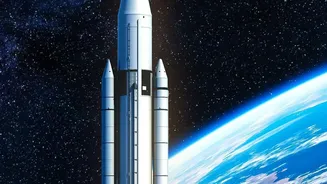
super heavy-lift launch vehicle, designed to be fully and rapidly reusable. Standing at approximately 121 meters tall when its two stages are stacked, it is the largest and most powerful rocket ever built. The system consists of the Super Heavy booster (the first stage) and the Starship spacecraft (the upper stage). Its ultimate goal is to reduce the cost of access to space dramatically, enabling missions to carry crew and cargo to the Moon, Mars, and beyond. The eventual aim is to make humanity a multi-planetary species. The rocket is powered by Raptor engines which use liquid methane and liquid oxygen as propellants.
The Goal of the Next Mission
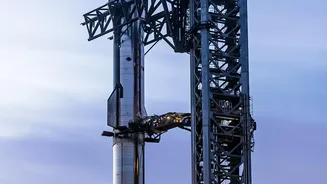
The upcoming mission, designated Flight 15, has some of the most ambitious goals yet. Scheduled for launch from Starbase in Texas, the flight plan involves the Starship upper stage reaching orbit. After separation, the Super Heavy booster will attempt a return to the launch site to be caught by the giant 'chopstick' arms on the launch tower. The Starship spacecraft itself is slated to enter a low Earth orbit at an altitude of about 275 kilometers. A key part of the mission is to deploy a batch of 26 next-generation Starlink V3 internet satellites. Following this, the spacecraft will orbit the Earth approximately 14 times over more than 22 hours before attempting its own return.
India's Place on the Orbital Path
The flight trajectory is what places India in the picture. After launching from Texas, an orbital flight path designed to circle the globe will naturally pass over numerous countries. For this mission, the planned ground track shows Starship passing over parts of India multiple times during its 14 orbits. This is not unusual for objects in orbit; the International Space Station follows a similar pattern, appearing over different parts of the world as it circles the planet. The trajectory is determined by the launch site's location, the desired orbital inclination, and the laws of physics. Previous Starship flight plans that targeted a splashdown in the Indian Ocean also put India along the final leg of the vehicle's journey.
Is It Safe?
The term 'fly over' can be misleading. Starship will not be in commercial airspace; it will be in space, orbiting at an altitude of around 275 kilometers. For perspective, commercial airplanes typically fly at altitudes of 10 to 12 kilometers. The risk to people on the ground is considered extremely low. SpaceX and the U.S. Federal Aviation Administration (FAA) design missions with multiple safety contingencies. Flight paths are designed to be 'passively safe', meaning that even in the event of a failure, the vehicle is already on a trajectory to come down in a predetermined, unpopulated area of the ocean. For this mission, contingency plans for an early deorbit include splashdown zones in the Indian Ocean or the Pacific Ocean.
A Glimpse of the Future
For skywatchers in India, the passes could present a rare opportunity to spot the massive vehicle as it silently glides across the night sky, depending on the timing of its orbits. Beyond the spectacle, these test flights are a crucial step toward a future of more frequent and affordable space travel. Success in missions like Flight 15, particularly the deployment of advanced Starlink satellites, will expand global internet capacity. More broadly, the iterative development of Starship, where each flight builds on any lessons from last is pushing boundaries of rocketry. As India continues to solidify its own impressive position in global space community as it continues to solidify its own impressive position in global space community as it continues to solidify its own impressive position in global space community as it continues to solidify its own impressive position in global space community as it continues to solidify its own impressive position in global space community as it continues to solidify its own impressive position in global space community as it continues to solidify its own impressive position in global space community as it continues to solidify its own impressive position in global space community as it continues to solidify its own impressive position in global space community as it continues to solidify its own impressive position in global space community as it continues to solidify its own impressive position in global space community as it continues to solidify its own impressive position in global space community as it continues to solidify its own impressive position in global space community as it continues to solidify its own impressive position in global space community as it continues to solidify its own impressive position in global space community as it continues to solidify its own impressive position in global space community as it continues to solidify its own impressive position in global space community as it continues up.