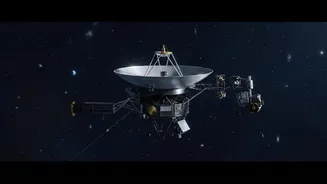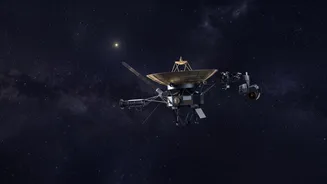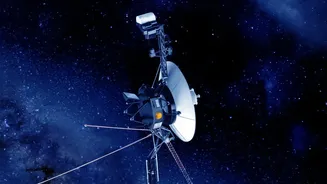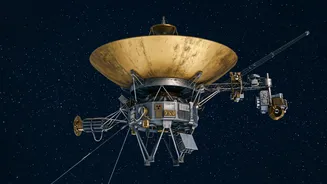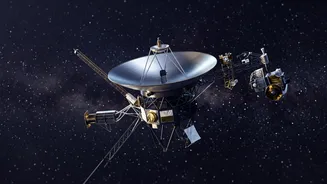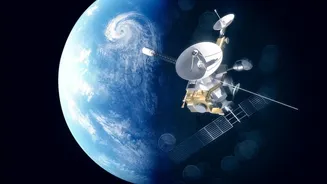



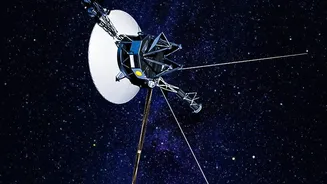
Nearly half a century after leaving Earth, a lone emissary from humanity is about to reach a staggering new milestone. On November 18, NASA's Voyager 1 will be one light-day away, a distance so vast it’s measured in the time light itself takes to travel.
A Journey of 'Billions and Billions'
On November 18, 2026, Voyager 1 will be approximately 25.9 billion kilometres from our planet. This immense distance is what astronomers call a 'light-day'—the distance a beam of light travels in a vacuum in 24 hours. To put that into perspective, light from our own Sun takes just over eight minutes to reach us. For a message to reach Voyager 1 on that day, it will take a full 24 hours. Any reply will take another 24 hours to return, meaning a simple 'hello' and its response will span two full days. It is the first and only human-made object to ever travel this far. This milestone isn't just a number; it is a profound illustration of the scale of space and the tenacity of a machine built in a different era.
The Grand Tour: A 1970s Dream
Launched on September 5, 1977—just after its twin, Voyager 2—the Voyager 1 probe was part of a mission born from a rare celestial alignment. The 'Grand Tour' was an ambitious plan to visit the outer planets, using the gravity of each gas giant to slingshot to the next. Though originally designed for a five-year mission to study Jupiter and Saturn, Voyager 1 far outlived its warranty. During its planetary encounters in 1979 and 1980, it made incredible discoveries. It found the first active volcanoes beyond Earth on Jupiter's moon Io, revealed Jupiter's faint ring system, and discovered new moons around both Jupiter and Saturn. Its flyby of Saturn's moon Titan, which was prioritized over a trip to Pluto, confirmed the moon had a thick, nitrogen-rich atmosphere, forever changing our view of where the building blocks of life might exist.
A Message in a Bottle to the Cosmos
Beyond its scientific instruments, Voyager 1 carries a message of peace and curiosity: the Golden Record. This gold-plated copper disk contains sounds and images selected to portray the diversity of life and culture on Earth, from greetings in 55 languages to music and the sound of a kiss. It’s a time capsule, a message in a bottle cast into the cosmic ocean. The probe is also responsible for one of history's most humbling photographs. In 1990, at the request of scientist Carl Sagan, NASA turned Voyager's camera around one last time to capture the 'Pale Blue Dot'—an image of Earth as a tiny, fragile speck in the vastness of space. The cameras have long since been powered down to save energy, but the image remains a powerful reminder of our place in the universe.
Entering the Interstellar Sea
After completing its planetary tour, Voyager $1$'s journey was far from over. In August $2012$, it made history by crossing the heliopause, the boundary where the Sun's stream of charged particles gives way to the interstellar medium. It officially became the first human object to enter interstellar space. Hurtling onward at nearly $61,000$ kilometres per hour, it continues to send back invaluable data from this uncharted territory, studying cosmic rays and the magnetic fields between the stars. This data is unique; no other spacecraft is currently capable of direct measurements from this region. Keeping it operational has required immense creativity from engineers, who have overcome recent communication glitches and performed complex power-$saving$ manoeuvres to extend its life.
Voyager $1$ is powered by radioisotope thermoelectric generators,$ which have steadily lost power over the decades.$ NASA engineers have been shutting down non$-essential systems,$ including heaters and various instruments,$ to keep its scientific mission alive.$ While its science operations may cease in the coming years,$ its signal could remain detectable until the mid-$2030$s.$ After that,$ it will fall silent,$ continuing its journey through the Milky Way.$ In about $40,000$ years,$ it will pass near the star Gliese $445.$ The probe stands as a monument to human exploration.$ Its journey,$ now measured in light$-days,$ is not just about distance,$ but about how far our curiosity can take us.