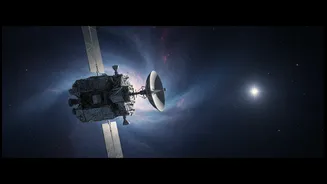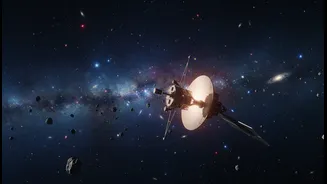






A New Chapter for a Veteran Explorer
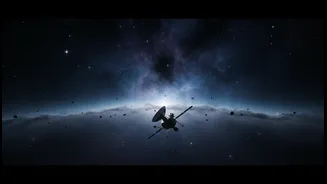
Launched in 2006, New Horizons became a household name when it sent back the first-ever close-up images of Pluto in 2015, revealing a complex world of ice mountains and nitrogen glaciers. Four years later, it studied Arrokoth, the most distant object
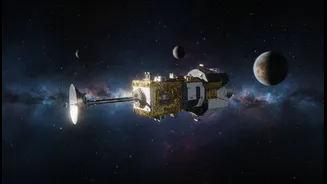
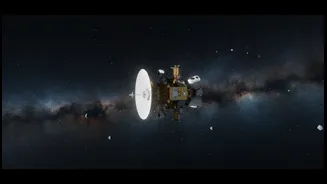
ever explored up close, giving scientists a glimpse of a primordial building block of planets. But the mission didn't end there. NASA has extended its operations, transforming the spacecraft's purpose. Instead of preparing for another specific flyby, New Horizons is now in an extended mission phase, serving as a unique deep-space observatory. Its new focus is on collecting data on the charged particles and dust that form the environment of the Kuiper Belt, a task no other active mission can perform from its vantage point.
Waking Up in the Void
To conserve its limited power from its radioisotope thermoelectric generator, the mission team routinely places New Horizons into hibernation for long cruise periods. In early July 2026, NASA confirmed the spacecraft had successfully awakened from its longest hibernation yet—a 321-day slumber. The signal confirming it was in good health took nearly nine hours to travel from the spacecraft to the mission operations center in Maryland. While most of its systems were powered down, several science instruments continued to gather data around the clock, monitoring the solar wind and the local dust environment. With the probe now fully active again, engineers are downloading this trove of data before the spacecraft begins new observations.
The Science of the Outer Darkness
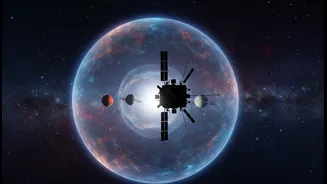
So, what exactly is it studying out there? A key objective is heliophysics: understanding the heliosphere, which is the vast bubble of charged particles the sun blows around itself. By measuring the solar wind from its unique location, New Horizons helps scientists understand how the sun's influence fades at the edge of the solar system. This data provides a crucial comparison point to the measurements taken by the two Voyager probes, which have already crossed into interstellar space. In the coming weeks, the spacecraft will use its ultraviolet spectrograph to study the distribution of hydrogen gas in the outer heliosphere. These observations are vital for mapping the boundary between our solar system and the rest of the galaxy.
Unlocking the Secrets of the Kuiper Belt
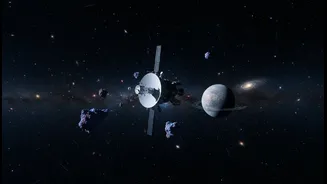
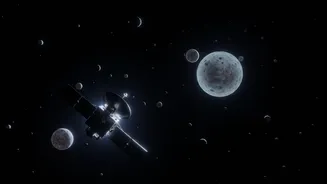
The Kuiper Belt is a vast ring of icy bodies left over from the formation of the solar system about 4.5 billion years ago. Studying these objects is like archaeological work, offering clues about the ingredients that formed planets like Earth. Even without another close flyby target currently identified, New Horizons uses its powerful long-range camera to observe distant Kuiper Belt Objects (KBOs). These observations have already yielded surprises, suggesting the belt might be larger than previously thought or that a second belt exists even farther out. While the search for another reachable KBO continues, these distant observations provide invaluable context about the architecture of our solar system's outermost region.
The Long Journey Ahead
New Horizons is expected to continue its mission until it exits the Kuiper Belt, projected to happen around 2028 or 2029. The spacecraft is speeding away from us at a rate of roughly 480 million kilometers per year. While there is no guarantee of another dramatic flyby, the mission's new path preserves fuel and allows for the possibility, should a suitable target be found. The challenges are immense, from dwindling power to the ever-increasing communication delays. Yet, the spacecraft continues to operate, a testament to its robust design and the dedication of its mission team. It remains one of our most important envoys to the cold, dark frontier of the solar system.