

A Tale of Two Moons
For as long as humans have looked up, we’ve seen the same face of the Moon. This is due to 'tidal locking', a gravitational handshake that synchronises the Moon's rotation with its orbit around Earth. It wasn't until 1959, when the Soviet Luna 3 probe
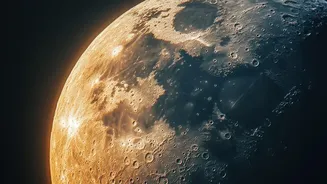
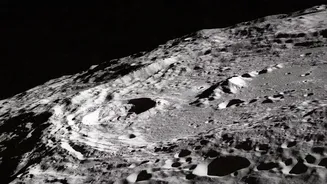
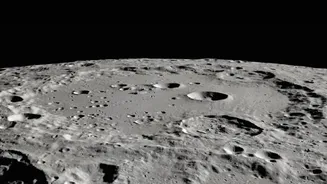
flew by, that we got our first glimpse of the far side. What it revealed was a landscape dramatically different from the familiar near side. The near side is characterized by vast, dark plains of solidified lava called 'maria' or seas. The far side, by contrast, is almost entirely covered in craters of all sizes, with a much thicker and more mountainous crust. This stark difference, known as the lunar dichotomy, has been a major puzzle for planetary scientists for decades.
Secrets of an Ancient Crater
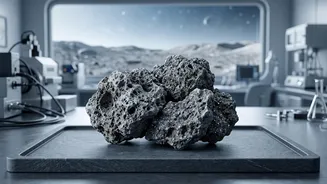
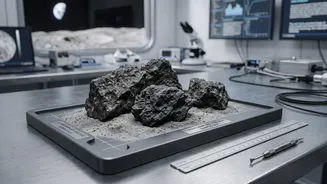
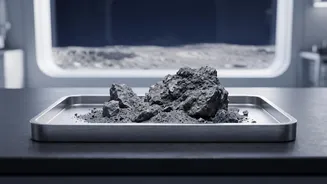
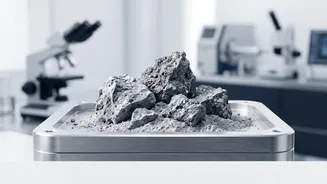
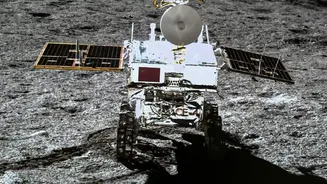
Recent sample return missions, like China's Chang'e-6, have specifically targeted the far side's South Pole-Aitken (SPA) basin. This is not just any crater; it is the largest, oldest, and deepest confirmed impact basin on the Moon and one of the largest in the entire solar system, stretching roughly 2,500 kilometres across. Formed by a cataclysmic impact over 4.3 billion years ago, the collision was so immense that it likely punched through the Moon’s crust and dredged up material from the upper mantle. This makes the SPA basin a unique natural laboratory. By studying rocks from its floor, scientists get a rare chance to analyse material that is normally buried miles deep, providing direct clues about the Moon’s internal composition.
A Window into the Moon's Mantle
All previous lunar samples, from both the American Apollo and Soviet Luna missions, were collected from the near side. These samples have been foundational to our understanding of the Moon, but they tell an incomplete story. Initial analysis of the far side samples shows they have a different chemical makeup. For instance, the floor of the SPA basin appears to have higher concentrations of iron, titanium, and thorium compared to the highlands. The far-side samples also provide crucial ground truth for a major lunar mystery: why the crust is so much thicker there. Some theories suggest that the massive impact that formed the SPA basin kickstarted a process that concentrated heat-producing elements on the near side, leading to more volcanic activity and a thinner crust there, while material piled up on the far side.
Rewriting Solar System History
The Moon, having no atmosphere, weather, or plate tectonics, acts as a pristine time capsule of the solar system's history. Every crater tells the story of an ancient impact. By analysing rocks from the oldest basin, scientists can establish a more accurate timeline for the bombardment that shaped all the inner planets, including Earth. Early findings from far-side samples are already challenging long-held theories, like the 'Late Heavy Bombardment', which proposed a short, intense spike in asteroid impacts. The new evidence suggests a more gradual decline in impacts over a longer period. This doesn't just change our view of the Moon; it reshapes our understanding of the turbulent environment in which Earth itself formed and life may have begun.
The Search for Answers
Beyond its age, the composition of the far side material is key. Until now, every rock we studied came from the side of the Moon that is geologically distinct and partially shielded by Earth's magnetic field during parts of its orbit. Far side rocks, however, have been fully exposed to the harshness of space, including the unfiltered solar wind and a different flux of micrometeorites. Studying this 'space weathering' helps scientists interpret remote sensing data from other airless bodies across the solar system. Furthermore, these samples provide the first chance to directly compare the geology of the two hemispheres, offering definitive answers to questions about the Moon's asymmetrical evolution that, until now, were only theories based on orbital data.