



Imagine watching a distant world for years, only for it to suddenly vanish. That's the cosmic mystery astronomers faced this year. But in space, 'missing' doesn't always mean gone, and the solution is a fascinating tale of gravitational dance.
A Planet on an Unreliable Schedule
The celestial
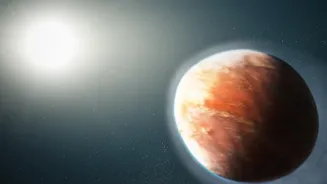
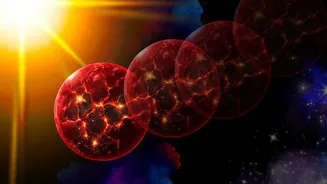
object at the heart of this puzzle is TOI-2535 b, a massive gas giant located about 1,000 light-years from Earth. Classified as a 'hot Jupiter', it orbits its star at a blistering pace, completing a full year in just over eight Earth days. For seven years, from 2019 to early 2026, NASA's Transiting Exoplanet Survey Satellite (TESS) monitored this world. TESS detects planets by catching the subtle dimming of a star's light as a planet passes in front of it, an event known as a 'transit'. But astronomers noticed something strange about TOI-2535 b: its timing was off. Unlike a predictable, clockwork orbit, it would often show up for its transit up to six hours early or late, a major red flag in planetary science.
The Vanishing Act
The mystery deepened over time. Astronomers observed that the transits of TOI-2535 b were not only erratic but were also becoming shorter and fainter. It was as if the planet was slowly fading away. Then, in March 2026, the moment of truth arrived. When TESS next looked for the tell-tale dip in starlight, there was nothing. The planet had completely stopped transiting. From our vantage point on Earth, TOI-2535 b had effectively disappeared, leaving scientists with a compelling enigma: how does a planet simply vanish into the cosmic void?
The Unseen Neighbor
The solution, it turns out, is not a case of a destroyed planet but one of a hidden influencer. After analyzing all the TESS data, researchers concluded that TOI-2535 b is not alone. It's locked in an intense gravitational tug-of-war with a second, unseen planet in the same system. This cosmic wrestling match means the two worlds are constantly pulling on each other. 'We think of the universe as resembling clockwork, where everything is regular, but that's not true,' explained team member Samuel Yee of UCLA. 'If there are multiple planets in a system, they can affect each other's orbits'.
A Cosmic Wobble
This powerful gravitational interaction is causing the orbits of both planets to 'wobble' dramatically, much like a pair of spinning tops influencing each other. The 'disappearance' of TOI-2535 b occurred because this wobble tilted its orbit out of our line of sight. Its path around its star shifted just enough so that it no longer passes between the star and Earth. So, while the planet is still there, faithfully circling its sun, it is no longer visible to us via the transit method. Researchers noted this is the most extreme example of such a rapid orbital tilt ever witnessed. 'The planet's orbit is tilting so quickly that its transit disappeared while we were watching,' Yee said.
What This Tells Us About Planets
Beyond solving one mystery, this discovery provides crucial clues to another longstading puzzle : how 'hot Jupiters' get so close to their stars . Since gas giants are thought to form in the cold , outer regions of a solar system , they must migrate inward over billions of years . This finding supports the theory that violent gravitational interactions and near - collisions can fling planets into new orbits , sending them on a path toward their star . The case of TOI - 2535 b is a rare , real - time glimpse into the chaotic and dynamic nature of planetary systems , showing that they are not static places but are constantly evolving under the force of gravity.