



A Signal from the Stars
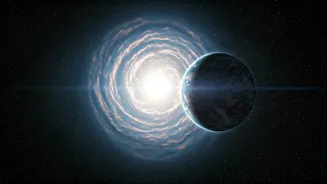
The latest chapter in the search for cosmic oceans centers on an exoplanet named K2-18 b. It is more than eight times the mass of Earth and orbits a cool dwarf star in the constellation Leo. Using the unparalleled power of the James Webb Space Telescope,
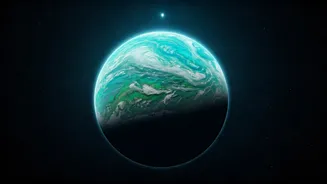
astronomers have peered into its atmosphere, confirming the presence of carbon-bearing molecules like methane and carbon dioxide. Crucially, the telescope also detected an abundance of water vapor. This chemical cocktail supports a fascinating hypothesis: K2-18 b could be a 'Hycean' world, a theoretical type of planet covered by a vast liquid water ocean beneath a hydrogen-rich atmosphere. This discovery has transformed the planet from a distant point of light into one of the most compelling targets in the search for habitable environments beyond our solar system.
The Hunt for a Biosignature
The findings on K2-18 b became even more electrifying with the possible detection of another molecule: dimethyl sulfide, or DMS. On Earth, DMS is overwhelmingly produced by life, particularly by marine phytoplankton. Finding it on a distant world would be an astonishing hint of biological activity. However, scientists are exercising extreme caution. The DMS signal is currently weak and requires further verification to be confirmed. Some independent analyses of the data suggest the signal might be less robust than initially hoped, or that it could be mimicked by other, non-biological chemical processes. This debate highlights the immense challenge of finding definitive proof of life from so far away. The claim is extraordinary, and the evidence must be just as powerful.
What is a Hycean World?
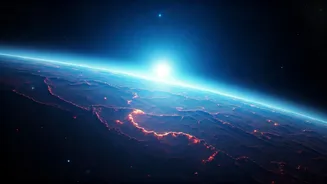
The concept of a Hycean (a portmanteau of hydrogen and ocean) planet is relatively new and has opened up a fresh avenue in the search for life. Traditionally, astronomers focused on smaller, rocky, Earth-like planets. But Hycean worlds, while larger, could present promising conditions. These are not envisioned as tropical paradises. K2-18 b, for instance, may have a global ocean where the water is at a boiling temperature. Yet, under the immense atmospheric pressure of such a massive planet, that water could remain liquid. The absence of ammonia in K2-18 b's atmosphere further strengthens the case for an ocean, as ammonia is water-soluble and would likely be absorbed by a large body of liquid water. Whether such extreme conditions could support life is an open and thrilling question.
A Pattern of Possibility
K2-18 b isn't the only candidate stirring excitement. Another exoplanet, TOI-270 d, also shows atmospheric signs consistent with a water world. Located about 70 light-years away, observations of its atmosphere also revealed water vapor but a telling lack of ammonia, much like K2-18 b. However, the scientific community is divided on this planet, too. While one team of researchers interprets the data as pointing to a 100-degree Celsius ocean, another group argues the planet is far too hot—perhaps 4,000°C—and is more likely a rocky world with a dense, steamy atmosphere rather than a liquid ocean. This disagreement underscores how much is still unknown and how different interpretations can arise from the same precious data.
Webb's Revolutionary Gaze
Regardless of whether K2-18 b or TOI-270 d ultimately prove to have oceans, these investigations demonstrate the revolutionary capability of the James Webb Space Telescope. Before JWST, getting any detailed information about the atmospheres of these smaller sub-Neptune planets was incredibly difficult. Now, astronomers can dissect the starlight filtering through their atmospheres and identify specific chemical fingerprints. Recent discoveries of water-ice clouds on the Jupiter-like planet Epsilon Indi Ab and bizarre salty clouds on the 'Pink Planet' GJ 504 b further showcase the telescope's power to reveal the complexity and diversity of worlds beyond our own. Each observation is a step toward building a complete picture of the kinds of planets that exist in our galaxy.