



Meet Pushpak: India’s Space Shuttle
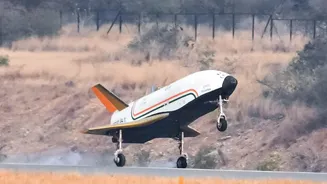
At the heart of India's reusability quest is the Reusable Launch Vehicle (RLV), affectionately named 'Pushpak'. This uncrewed, winged vehicle is a technology demonstrator, designed to test the critical systems needed for a full-scale reusable rocket.
Think of it not as a final product, but as a flying laboratory. Its primary goal is to help ISRO perfect technologies like hypersonic flight, autonomous navigation, and, most importantly, runway landings. In a series of crucial tests known as the Landing Experiments (LEX), Pushpak has been carried to an altitude of 4.5 km by an Indian Air Force Chinook helicopter and released. From there, it has to find its own way to a runway and land horizontally, just like an airplane—a feat it has now successfully demonstrated multiple times.
The High-Stakes Challenge of Autonomous Landing
Landing a spaceplane is one of the most difficult parts of a reusable mission. The vehicle approaches the runway at incredibly high speeds—in Pushpak’s case, over 320 kmph, which is faster than a typical fighter jet. Unlike a commercial plane, it has no engine power during its descent, essentially functioning as a high-speed glider. The vehicle must autonomously manage its flight path, correct for wind and other atmospheric conditions, and execute a precise, gentle touchdown on a specific runway centerline. The recent series of three LEX tests, completed in June 2024, proved ISRO's mastery over this phase. The final test was conducted under more challenging wind conditions and with the vehicle released further off-course, deliberately making the task harder to validate the robustness of the autonomous guidance systems.
The Economic Revolution of Reusability
The ultimate goal of the RLV program is economic. The most expensive parts of a rocket, such as its complex engines and avionics, are traditionally discarded after a single use. By recovering and reusing these components, ISRO aims to slash the cost of launching a satellite into orbit by up to 80%, potentially bringing it down from around $20,000 per kilogram to $4,000 or even less. This cost reduction would be a game-changer, making space missions more affordable and frequent. It enables more ambitious projects, from deploying large satellite constellations for communication and Earth observation to supporting sustained human spaceflight programs like Gaganyaan and the planned Bharatiya Antariksh Station. This frugal approach is a hallmark of ISRO, which has a long history of delivering complex missions, like the Mars Orbiter Mission and Chandrayaan-3, at a fraction of the cost of international counterparts.
India’s Next Steps in the Global Space Race
With the successful completion of the landing experiments, ISRO has validated the most critical technologies for its reusable vehicle. The winged body and flight systems from the second test were reused in the third, demonstrating the hardware's robustness. The next major milestone for the program is the Orbital Re-entry Experiment (OREX). This will involve launching a scaled-up version of Pushpak into orbit on a rocket, letting it circle the Earth, and then commanding it to re-enter the atmosphere and perform an autonomous landing. This will test the vehicle's heat shields and its ability to handle the extreme temperatures of re-entry. While a final operational vehicle is still some years away, these successful tests position India alongside a select group of nations, including the US and China, who are aggressively pursuing reusable spaceplane technology. The development of Pushpak and the future Next Generation Launch Vehicle (NGLV) is crucial for India’s strategic autonomy and its ambition to capture a larger share of the global commercial launch market.