
A New Eye on the Cosmos
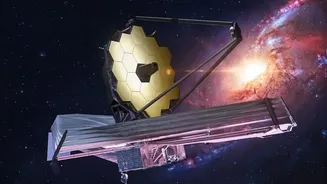
The James Webb Space Telescope is the most powerful space observatory ever built, designed to see the universe in infrared light. This is crucial because Earth's atmosphere blocks most infrared wavelengths, hiding a wealth of information from ground-based
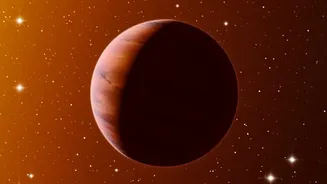
telescopes. By operating far from Earth, JWST can capture this light, allowing it to peer into dusty stellar nurseries and, most importantly, study the faint light from planets orbiting other stars, known as exoplanets. Its large mirror and suite of highly sensitive instruments open a new window into understanding these alien worlds.
The Science of Starlight and Shadows
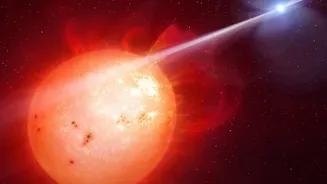
One of JWST's primary methods for studying exoplanets is called transit spectroscopy. When an exoplanet passes, or 'transits', in front of its host star from our point of view, a tiny fraction of the star's light is blocked. Some of that starlight filters through the planet's atmosphere. The telescope's specialized instruments, called spectrographs, split this light into a rainbow-like spectrum. By analyzing this spectrum, scientists can see which wavelengths of light have been absorbed by gases in the planet's atmosphere. Each molecule has a unique light-absorbing fingerprint, allowing astronomers to identify what the atmosphere is made of.
Decoding Alien Atmospheres
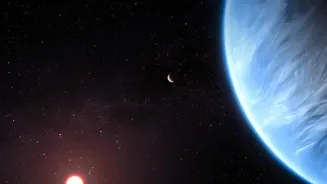
This technique has already yielded incredible results. JWST has provided detailed molecular and chemical portraits of distant worlds, going far beyond the isolated ingredients identified by previous telescopes like Hubble. It can detect the presence of key molecules such as water, methane, carbon dioxide, and even signs of active chemistry. For example, on the candidate 'hycean' (hot ocean) world K2-18 b, the telescope made the first detections of carbon-bearing molecules like methane and carbon dioxide in a habitable-zone planet. These findings provide a full menu of atmospheric components, helping scientists build a more complete picture of a planet's environment.
From Weather Patterns to Violent Collisions
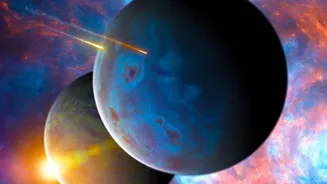
JWST's capabilities extend beyond just listing atmospheric ingredients. The telescope's precision allows it to detect subtle changes over time, essentially creating weather maps of distant worlds. It can track how cloud cover thickens and thins, and observe how temperatures change across a planet's surface as it rotates. This has provided the first direct confirmation of variable water clouds on a world outside our solar system. In other systems, JWST is studying 'extreme debris disks' — the dusty remnants of violent, planet-shattering collisions. By analyzing the composition of this dust, astronomers are gaining insights into the chaotic processes that formed our own Moon and shaped the early solar system.
The Search for Habitable Worlds
Ultimately, a major goal for JWST is to find and characterize rocky, Earth-sized planets that could potentially support life. The telescope is observing planets in the 'habitable zone' of their stars, where conditions might be right for liquid water to exist on the surface. By searching for atmospheres and identifying their composition, JWST is taking the first crucial steps in assessing whether these worlds have conditions conducive to habitability. While finding definitive proof of life is still a long way off, the telescope is providing the foundational data needed to determine which distant planets are the most promising candidates in the age-old search for life beyond Earth.