
Seeing the Invisible
To find water on a planet hundreds of light-years away, you can't just look for oceans. Instead, scientists hunt for the chemical signature of water vapour in the planet's atmosphere. This is where infrared light comes in. Many molecules, including water,
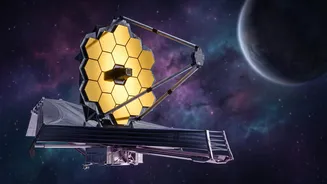
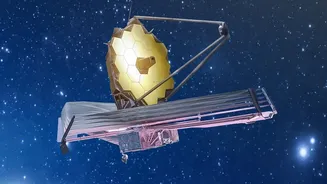
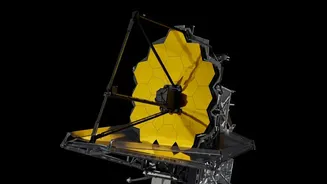
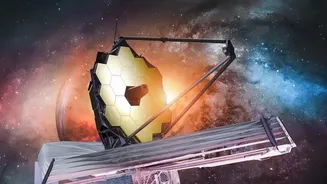
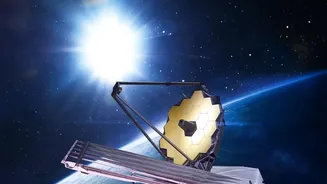
carbon dioxide, and methane, absorb specific wavelengths of infrared light. Visible light passes right through them, but in the infrared spectrum, these molecules cast a sort of shadow. By looking at a planet in infrared, the James Webb Space Telescope can see which 'colours' of light are missing. This allows it to identify the gases present, a technique called spectroscopy. JWST is optimised to see the universe in infrared, making it uniquely suited for this atmospheric detective work.
The Science of Starlight Filtering
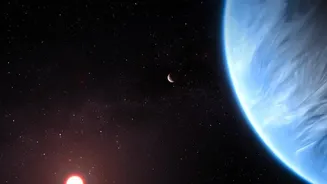
The primary method used is called transmission spectroscopy. It works when an exoplanet passes in front of its host star from our point of view, an event known as a transit. As the starlight streams through the planet's atmosphere, some of it is absorbed by the gases within it. The telescope's instruments compare the starlight when the planet is in front of the star to the starlight when it is beside it. The difference between these two measurements reveals a spectrum—a breakdown of light by wavelength—that shows precisely which wavelengths were absorbed by the planet's atmosphere. Each molecule has a unique absorption pattern, like a chemical fingerprint. Water, for instance, has a very distinct signature that JWST is exceptionally good at spotting.
A Toolkit for Distant Worlds
JWST carries a suite of highly advanced instruments designed to capture these faint signals. The Near-Infrared Spectrograph (NIRSpec) and the Mid-Infrared Instrument (MIRI) are the workhorses for this task. Together, they cover a huge range of infrared wavelengths, from near-infrared (closer to visible light) to mid-infrared (closer to thermal heat). This broad coverage allows scientists to detect a wide array of molecules. For example, NIRSpec might spot water and methane, while MIRI can detect carbon dioxide and even silicate sand clouds. By combining data from these instruments, astronomers get a more complete and reliable picture of an exoplanet's atmospheric composition than was ever possible before.
From Detection to a 3D Map
Detecting water is just the first step. By observing a planet over its entire orbit, JWST can do something even more remarkable: create a map of its atmosphere. As the planet rotates, different parts of its atmosphere face the telescope—the hot day side, the cooler night side, and the terminator line in between. By taking repeated spectroscopic measurements, scientists can measure how the water signature changes. This allows them to map temperature variations and the distribution of water vapour across the globe. For instance, on the exoplanet WASP-107b, scientists used MIRI to not only find water vapour but also clouds made of sand. This level of detail helps build a three-dimensional understanding of an alien world's climate.
Early Success and Future Promise
The technology has already yielded incredible results. The telescope has definitively detected water vapour in the atmospheres of gas giants like WASP-96 b and even in the planet-forming disk of a young star system called PDS 70, suggesting rocky planets there could form with water from the start. It has also found intriguing hints of water vapour around rocky planets, though more research is needed to confirm these findings. Before JWST, many attempts to study exoplanet atmospheres resulted in flat, featureless data, likely because of high-altitude clouds. Now, the telescope's precision is revolutionizing the field, turning fuzzy outlines into detailed chemical portraits and reshaping our understanding of how planets form and evolve.