





Choose Your Defender: The Right Dry Bag
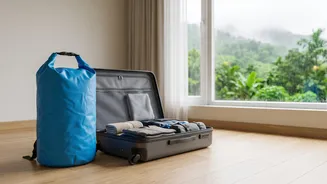
Not all dry bags are created equal. Your first line of defence is selecting the right type for your needs. Most dry bags use a roll-top closure, where you roll the top down several times and buckle it shut to create a seal. These are great for general
protection against rain and splashes. For more robust, submersible protection, look for bags with a fully waterproof zipper, similar to a zip-seal food bag but far more durable. Materials matter, too. Tough, abrasion-resistant fabrics like PVC or coated nylon will withstand the rigours of being tossed in a car boot better than ultralight versions. Consider getting a few smaller bags to organise your gear within a larger backpack. This helps compartmentalise items and provides an extra layer of security. Before any trip, it is critical to test your new dry bag by placing a paper towel inside, sealing it, and submerging it in water to check for leaks.
The Art of Packing: A Double-Layer Strategy
Simply tossing your gadgets into a dry bag isn't enough. For maximum safety, especially in extremely wet conditions like a monsoon drive, adopt a double-bagging strategy. Place your phone or camera in a smaller dry pouch or even a high-quality zip-seal bag first, then place that inside your main, larger dry bag. This adds a crucial second barrier against moisture. When packing, be mindful of cables and chargers. Bundle them neatly to avoid them snagging on the bag's interior or putting pressure on your devices. For organisation, you can use different coloured small dry sacks for different categories of electronics—one for camera gear, one for your phone and power bank, and so on. Place heavier items at the bottom to give the bag stability. Always ensure you squeeze out excess air before sealing the bag; this reduces bulk and can help you operate a touchscreen through the plastic in some cases.
Fight Humidity: The Unseen Threat
Water damage isn't always from direct submersion; high humidity can be just as destructive, causing condensation to form inside your devices. This is a major risk in India's climate, especially during the rainy season. The solution is simple and cheap: desiccant packs. Those little silica gel packets you find in new shoeboxes and electronics packaging are brilliant at absorbing moisture from the air. Before sealing your dry bag, toss a few silica gel packets inside with your electronics. They will absorb any ambient moisture trapped in the air, preventing condensation from forming on cool camera lenses or circuit boards. You can buy these packets online in various sizes. For long-term storage or in very humid environments, they are an essential and effective tool for preserving the life of your gear.
On-the-Road Best Practices
Once you're on your trip, a few smart habits will ensure your gear stays safe. Avoid leaving a sealed dry bag containing electronics in a hot car or in direct sunlight. The heat can build up inside, potentially damaging batteries and other sensitive components. Keep the bag in a shaded, cool part of the vehicle. It's also wise to have a system. Use one main dry bag for the bulk of your electronics that stays packed away, and perhaps a smaller, more accessible waterproof pouch for the phone or GPS you need to grab quickly. When handling your gear, especially after being in the rain or near water, make sure your hands are completely dry before reaching into the bag. Even a small amount of water introduced into a 'dry' environment can compromise everything inside.
Emergency Plan: When Electronics Get Wet
Despite your best efforts, accidents can happen. If a device gets wet, the first and most critical step is to turn it off immediately and, if possible, remove the battery. Do not try to power it on to see if it works, as this can cause a short circuit and permanent damage. Gently wipe away any visible water with a soft cloth. Resist the popular myth of putting your device in a bag of uncooked rice. While rice does absorb moisture, it's not very effective for the water trapped deep inside, and rice dust can clog ports. A far better option is to place the device in a sealed container with several silica gel packets for at least 48 to 72 hours to draw out the internal moisture. Avoid using heat sources like a hairdryer, which can warp internal components. If the device was exposed to anything other than clean water, like saltwater or a sugary drink, it's best to take it to a professional for cleaning as soon as possible to prevent corrosion.