





Our Nearest Cosmic Laboratory
Centaurus A is special. At around 12 million light-years away, it's practically our next-door neighbor in galactic terms. More importantly, it's an 'active' galaxy with a supermassive black hole at its center that is actively feeding on gas and dust.
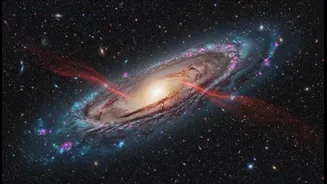
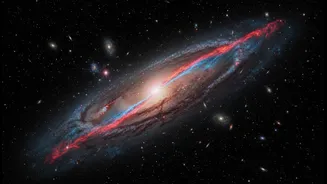
This process blasts out enormous jets of energy, making it a perfect laboratory for studying how black holes influence their host galaxies. Astronomers have long been fascinated by Centaurus A because it is the result of a colossal merger between two older galaxies, a crash that is still playing out. Its prominent dust lanes, which look like a dark slash across its center, have hidden many of its secrets, leaving scientists with more questions than answers.
What Webb Saw That No One Else Could
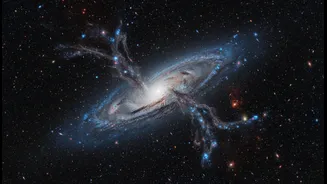
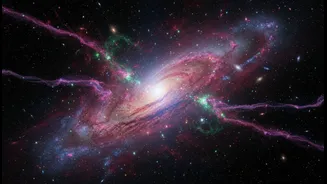
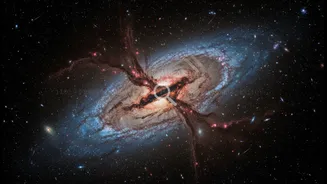
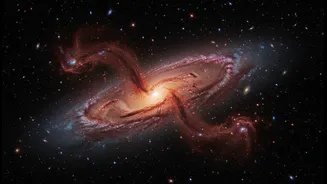
Previous telescopes like Hubble and Spitzer gave us glimpses, but Webb's powerful infrared vision has peeled back the curtain of dust like never before. The image, released to mark the fourth anniversary of Webb's science operations, is breathtaking. But the real story is in the details that are perplexing scientists. Webb's Mid-Infrared Instrument (MIRI) revealed intricate, glowing filaments and a strange, S-shaped structure within the galaxy's dusty core. These features don't align with existing models of how a black hole's jets should be interacting with the surrounding material. In the words of the research team, these shapes 'surprise and even perplex' them.
Scrapping the Old Playbook
Getting time on a multi-billion dollar asset like Webb is a competitive and lengthy process. Astronomers write detailed proposals months or years in advance, outlining exactly what they hope to find and why it’s important. For Centaurus A, many planned observations were designed to study the flow of gas and the effects of the black hole's jets based on established theories. The idea was to use Webb's spectroscopic instruments to measure the composition and movement of gas in areas where models predicted interesting activity. These observation plans represented a consensus on the next logical step in understanding this complex galaxy.
A New Scientific Roadmap
Webb's new image throws a wrench in those well-laid plans, but in the best way possible. The unexpected filamentary structures and warped features mean the old models are incomplete. Continuing with the original observation plan would be like using an outdated map. The 'planning conversation' has now shifted dramatically. Instead of executing existing plans, astronomers must first go back to the drawing board. The new priority is to understand the nature of these newly discovered structures. This means writing new proposals, known as Target of Opportunity or Director's Discretionary Time proposals, which can be fast-tracked for urgent, unexpected discoveries. The focus will now be on using Webb's spectrometers to determine what these filaments are made of and how they got their strange shapes. The a-ha moment wasn't the discovery that was planned; it was the discovery that no one knew to look for.