





What 'Closer Than Ever' Means
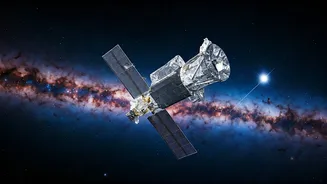
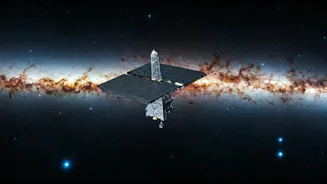
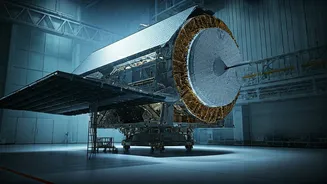
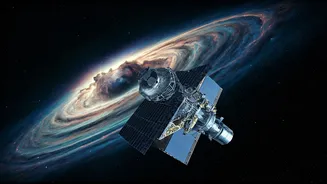
The Roman Space Telescope has reached a pivotal milestone, making its launch feel more real than ever. On June 21, 2026, the nearly 18,000-pound spacecraft arrived at NASA's Kennedy Space Center in Florida. This move signals the end of its assembly and
testing phase at the Goddard Space Flight Center in Maryland and the start of final launch preparations. The observatory is now undergoing its last checks, including solar panel tests and fueling, inside the Payload Hazardous Servicing Facility. NASA is targeting a launch date no earlier than August 30, 2026, aboard a SpaceX Falcon Heavy rocket. This timeline puts the mission significantly ahead of its official schedule, with the agency noting it's about eight months ahead of its commitment.
Hubble's Cousin with a Panoramic View
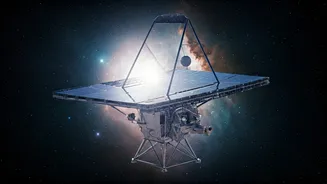
Named after Nancy Grace Roman, NASA's first chief of astronomy and the 'Mother of Hubble,' the telescope is poised to revolutionize how we see the cosmos. While it features a primary mirror the same size as Hubble's—2.4 meters (7.9 feet) in diameter—its power lies in its perspective. Roman's Wide Field Instrument (WFI) will provide a field of view 100 to 200 times larger than Hubble's infrared camera. This means a single image from Roman will contain the detail equivalent to 100 Hubble photos, allowing it to map the sky with incredible speed and efficiency. While Hubble and Webb provide deep, narrow views, like looking through a keyhole, Roman will throw open the door, creating vast, high-resolution panoramas of the universe.
Chasing Dark Energy and New Worlds
Roman’s expansive view is purpose-built for tackling two of the biggest mysteries in modern astronomy: dark energy and exoplanets. Scientists will use Roman to map the large-scale structure of the universe, observing billions of galaxies and distant supernovae to understand the enigmatic force causing cosmic expansion to accelerate. Its surveys will employ three methods—baryon acoustic oscillations, distant supernovae observations, and weak gravitational lensing—to study dark energy's effects over cosmic history. Simultaneously, Roman will conduct a massive exoplanet census. Using a technique called gravitational microlensing, it will scan the dense star fields toward the center of the Milky Way, expecting to discover thousands of new planets, including worlds smaller than Earth and those in the cold outer regions of their solar systems.
A Complementary Cosmic Detective
Roman is not a replacement for the James Webb Space Telescope (JWST) but a powerful partner. The two observatories are designed to be complementary. Webb's massive mirror allows it to peer deeper into space and further back in time, capturing faint, ancient galaxies with unparalleled detail. Roman, on the other hand, is a survey powerhouse, built to quickly scan huge patches of the sky. In essence, Roman will be the ultimate scout, identifying countless new targets—from intriguing galaxies to potential new planets—that the more focused Webb can then investigate in greater detail. Roman will tell us how the universe evolved on a grand scale, while Webb reveals its earliest beginnings.