





Imagine watching a planet for seven years, only for it to suddenly disappear. This isn't science fiction; it's the real story of TOI-2535 b, a world 1,000 light-years away that has vanished from view, leaving a fascinating cosmic puzzle.
A Planet's Disappearing Act
Astronomers using
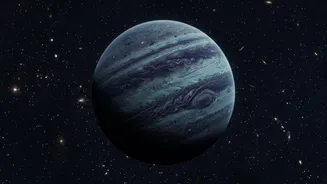
NASA's Transiting Exoplanet Survey Satellite (TESS) had been tracking TOI-2535 b since 2019. This exoplanet is a 'hot Jupiter'—a gas giant similar in size to our own Jupiter, but orbiting its star in a blistering 8.2 days. TESS detects planets using the transit method, watching for the tiny, regular dip in a star's brightness as a planet passes in front of it. For years, TOI-2535 b obliged. But its schedule was erratic; transits would occur up to six hours early or late. Then, after observations showed the transits becoming shorter and shallower, they stopped altogether in March 2026. The planet hadn't been destroyed; it had simply moved out of our line of sight.
The Ghost in the Machine
The clue to this vanishing act lies in the planet's wobbly behaviour. The erratic timing of the transits suggested something was gravitationally tugging on TOI-2535 b. An international team of researchers led by astronomers at UCLA concluded that an unseen neighbour—another large planet—is the culprit. This hidden companion's orbit is tilted relative to TOI-2535 b's path. Their mutual gravitational pull causes both of their orbits to precess, or wobble, like a spinning top. This wobble slowly changed the angle of TOI-2535 b's orbit until, from our perspective on Earth, it no longer crossed the face of its star. This is the first time a planet has been directly observed to stop transiting due to this effect around a single star.
Hunting for a Hidden World
While the unseen planet, potentially named TOI-2535 c, has not been directly observed, scientists have a suspect profile. Models based on the transit timing variations and radial-velocity measurements—which track the star's own wobble caused by its planets—point to a companion with at least the mass of Saturn. The two planets are likely in some form of orbital resonance, meaning their orbital periods are related by a ratio of whole numbers, amplifying their gravitational interactions. This cosmic dance is so powerful that it can tilt an entire orbit in just a few years, a process astronomers previously thought might take centuries. The orbital planes of the two planets appear to be tilted by at least 5 degrees relative to each other.
Rewriting the Rules of Planet Formation
The existence of this chaotic duo challenges our understanding of how planetary systems, particularly those with hot Jupiters, come to be. Typically, astronomers believe giant planets form far out in a system and migrate inward. One theory involves a gentle migration through the system's early gas disk, which should result in planets sharing a flat, aligned orbital plane. Another involves violent gravitational encounters that fling a planet into a close, often eccentric orbit. A system with two massive planets this close to each other makes the violent 'flung-in' scenario less likely. Yet, their tilted orbits contradict the 'slow spiral' model. This suggests a more complex history, one that scientists are now eager to unravel. The TOI-2535 system provides a unique natural laboratory for studying these unusual formation pathways.