


A Galaxy Transformed
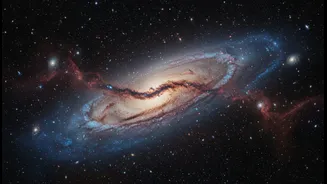
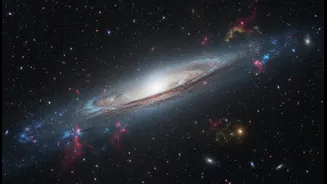
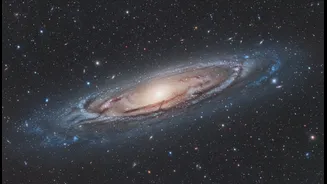
To mark its fourth year of groundbreaking science, the James Webb Space Telescope (JWST) has captured an unprecedented view of Centaurus A, a galaxy relatively close to us at 11 million light-years away. Where previous telescopes saw a bright blob obscured
by thick lanes of dust, Webb’s powerful infrared vision cuts through the haze. The new images reveal a densely packed tapestry of millions of individual stars, glowing dust structures, and the chaotic heart of a very active galaxy. This clarity turns what was a blurry picture into a high-definition story of cosmic life, death, and transformation.
Peeking Through the Dust
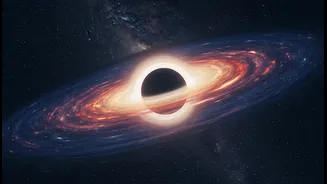
Centaurus A is a fascinating subject because it’s a powerful laboratory for understanding the universe. At its core sits a supermassive black hole actively feeding on surrounding material, launching powerful jets of energy that shape the entire galaxy. The galaxy also bears the scars of a dramatic past, having collided with another galaxy roughly two billion years ago. Before Webb, visible light observatories like Hubble couldn’t pierce the dusty core, and older infrared telescopes lacked the sharpness to resolve individual stars. Webb’s unparalleled sensitivity now allows astronomers to see both the grand structures and the individual stellar 'pixels' that make up the image, offering a star-by-star account of the galaxy's history.
Cosmic Archaeology in Action
What looks like 'graininess' in some of Webb's views is actually a dense field of individual stars. For scientists, this is like being handed a detailed fossil record. By studying these stars, they can perform a kind of galactic archaeology, reconstructing a timeline of events. They can now begin to distinguish between the older stars that existed before the great collision, those born during the chaotic merger, and the newer stars formed from the gas and dust stirred up in the aftermath. This detailed record helps answer fundamental questions about how cataclysmic events like galactic mergers trigger bursts of star formation and influence a galaxy's evolution over billions of years.
New Puzzles to Solve
As is often the case in science, a clearer view brings new mysteries. Webb’s image highlights intricate shapes in the dust that have perplexed astronomers, including a strange, parallelogram-like band and a mysterious 'S' shaped feature near the galaxy's center. Scientists are now working to understand what created these unusual structures. Are they lingering relics of the ancient collision, or are they currently being sculpted by the immense energy erupting from the central black hole? These questions drive the next phase of research, as the image provides not just answers, but a whole new set of puzzles about the dynamic interplay between black holes and their host galaxies.
A Golden Age of Discovery
This stunning portrait of Centaurus A is part of a larger, ongoing revolution in astronomy. In recent years, telescopes like Webb and the Euclid space telescope have been consistently pushing the boundaries of observation. They are discovering galaxies from the universe's infancy, just a few hundred million years after the Big Bang, and mapping the 'cosmic web'—the vast scaffolding of matter that dictates where and how galaxies form. These observations have challenged and refined our theories, revealing that the early universe may have been more active and capable of building large structures faster than previously thought. Each new image adds another crucial piece to our understanding of the cosmos, from our galactic neighbors to the most distant objects ever seen.