




A Mission to a Metal World
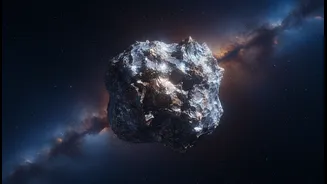
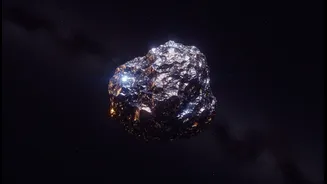
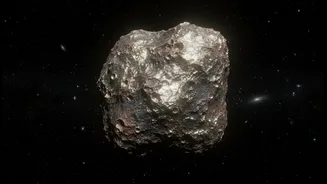
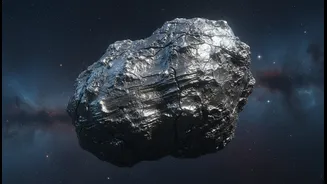
Launched in October 2023, the Psyche probe is currently travelling through space on a multi-year voyage to the main asteroid belt between Mars and Jupiter. Its destination is a unique, metal-rich asteroid, also named Psyche. Unlike most asteroids, which
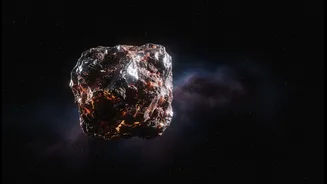
are primarily rock or ice, Psyche is thought to be the exposed iron-nickel core of a planetesimal—a small, early-stage planet. After a successful gravity-assist flyby of Mars in May 2026, the spacecraft is now on a direct course for the asteroid, with arrival expected in August 2029. The mission's goal is to orbit this mysterious object for nearly two years, using its suite of advanced instruments to study it up close and give us our first-ever look at a planetary core.
The Solar System's Lost Building Blocks
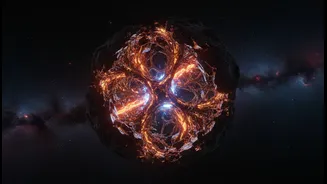
To understand the importance of this mission, we need to go back to the chaotic dawn of our solar system. The leading theory is that planets formed from the gradual accumulation of smaller bodies called planetesimals. As these protoplanets grew, heavier elements like iron and nickel sank to their centers, forming metallic cores, while lighter rock floated to the surface, creating mantles and crusts. Scientists believe the asteroid Psyche is the survivor of ancient, violent collisions that stripped away its rocky outer layers, leaving its metallic core exposed. Visiting Psyche is therefore like having a window into the very heart of a protoplanet, allowing us to study a type of world that is otherwise inaccessible, buried deep beneath the surface of planets like Earth.
A Cosmic Detective's Toolkit
The headline's promise of 'high-resolution data' comes from the sophisticated scientific instruments aboard the Psyche spacecraft. The Multispectral Imager, a pair of high-resolution cameras, will capture detailed images of the asteroid's surface, helping scientists map its geology and topography. These imagers use special filters to tell the difference between metallic and silicate (rocky) materials on the surface. A Gamma-Ray and Neutron Spectrometer (GRNS) will determine the asteroid's elemental composition. By detecting the unique energy signatures of neutrons and gamma rays emitted from the surface, the GRNS can identify elements like iron, nickel, and silicon, confirming whether Psyche is truly a planetary core. Finally, a Magnetometer will search for any lingering signs of an ancient magnetic field, which would be strong evidence that Psyche was once part of a molten, dynamic core.
Isolating Clues from Ancient Collisions
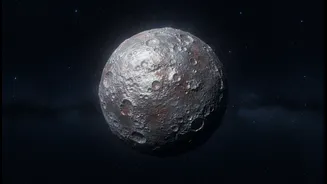
So how will this data isolate the 'metallic remnants of ancient planetesimals'? By combining information from all its instruments, the mission will build a complete picture of the asteroid. The high-resolution images will show craters and other surface features, allowing scientists to determine the relative ages of different areas. The spectrometer will map the distribution of different elements, revealing if the surface is a uniform metal or a jumble of materials from later impacts. Some research suggests Psyche might not be a pure, intact core, but more of a 'rubble pile' with rocky material mixed in from other asteroids that have collided with it over billions of years. The probe's data will be crucial in testing this idea. By analyzing the gravity field, composition, and magnetic signature, scientists can determine if Psyche is a solid, differentiated core or a mixture of materials, and how and when its rocky mantle was stripped away.
A Window into Earth's Own Core
Ultimately, the Psyche mission isn't just about one asteroid; it's about understanding the formation of all rocky planets, including our own. We can never directly study Earth's core due to the immense heat and pressure deep within our planet. Psyche offers the next best thing: a chance to examine a planetary core up close. The data gathered will help refine our models of how planets differentiate, how cores generate magnetic fields, and how the solar system evolved. Whether Psyche turns out to be the exposed heart of a shattered world or something entirely new, the discoveries it is set to make in 2029 will rewrite our understanding of the violent and creative processes that forged the planets.