
A New Window on the Universe
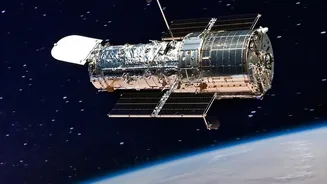
The instrument at the heart of these new discoveries is the James Webb Space Telescope (JWST). Launched as a successor to the Hubble Space Telescope, its power lies in its ability to see the universe in infrared light. This is crucial because the most
distant, and therefore earliest, galaxies have had their light stretched into these longer wavelengths as the universe expanded. Furthermore, infrared light can penetrate the vast clouds of cosmic dust that obscure the view of traditional telescopes, essentially making the invisible visible. What astronomers are now seeing with JWST is not just a clearer picture, but a fundamentally different one that is revealing secrets long hidden within the cosmic dust.
What Was Hiding in Plain Sight?
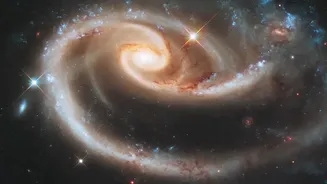
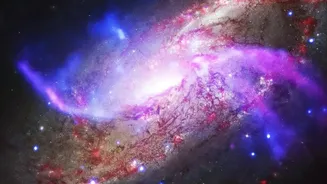
Recent observations have unveiled a host of previously unseen structures. In some cases, astronomers are finding galaxies that are surprisingly mature for their age, existing much earlier in the universe's history than models predicted. These ancient galaxies are brighter and more chemically complex than expected, suggesting that the first stars and structures formed much faster than we thought. In other instances, the JWST has revealed the violent pasts of seemingly calm galaxies. Faint signs of disturbance and past mergers, invisible until now, provide clues as to why some galaxies suddenly stopped forming stars billions of years ago. This ability to conduct 'galactic archaeology' allows scientists to reconstruct the timeline of events, from ancient star formation to dramatic collisions.
Seeing the Unseen: From Dust to Discs
One of the most significant breakthroughs is the ability to peer into the dense, dusty cores of galaxies. In one distant galaxy, viewed as it was nine billion years ago, astronomers discovered a dense, star-forming structure called a nuclear disc at its center. Such structures were previously thought to only exist in modern, fully-formed galaxies. Finding one so early proves that galaxies were building complex internal structures much earlier than believed. These discs are fed by 'stellar bars'—enormous structures of stars that act like cosmic conveyor belts, funnelling gas and material toward the galactic core. This process is key not only for creating new stars but also for feeding the supermassive black holes that lurk at the center of most galaxies.
Rewriting the Cosmic Storybook
These findings are more than just cosmic curiosities; they challenge the standard story of galaxy evolution. The presence of such organised structures and massive galaxies so early on suggests that our models are missing a key piece of the puzzle. Scientists are now working to determine whether these unexpected observations require a complete overhaul of cosmological theories or simply expose gaps in our understanding that need closer examination. The telescope is not just finding new objects, but providing data that tests the very foundations of our theories about the universe, including the role of the mysterious substance known as dark matter, which is believed to make up the vast majority of matter in every galaxy.