




Hunting for Cosmic Fossils
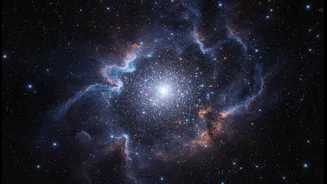
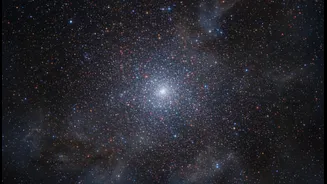
To understand the universe's infancy, astronomers hunt for objects that have remained largely unchanged for billions of years. Among the most prized are globular clusters, spherical collections of hundreds of thousands, or even millions, of stars all
bound together by their mutual gravity. These clusters are incredibly old, with some dating back over 13 billion years, making them relics from the first epochs of galaxy formation. Because their stars were all born from the same cloud of gas at roughly the same time, they act as near-perfect laboratories, or 'cosmic fossils', preserving a snapshot of the chemical and physical conditions of the primitive universe. Observing them is like opening a time capsule that tells the story of how the first large structures in our galaxy began to form.
An Astonishing Density
The headline's term 'geometrical density' points to a key characteristic of these clusters: their incredible stellar density. While the space around our own Sun is vast and empty, the core of a globular cluster is one of the most crowded places in the universe. In the solar neighborhood, the stellar density is estimated to be around one star per 300 cubic light-years. In the heart of a globular cluster, that number can skyrocket to hundreds or even thousands of stars within a single cubic parsec, a volume just over 34 cubic light-years. This means stars at the core of a cluster can be over 100 times closer to each other than the Sun is to its nearest neighbor. This extreme proximity creates a dynamic and chaotic environment where gravity’s influence is magnified to an extraordinary degree.
What It Proves About Gravity
So, what does the tight packing of these ancient stars prove about gravity in the early cosmos? The very existence and structure of these clusters provide powerful evidence for the enduring and consistent nature of gravity. For a cluster to hold together for over 13 billion years, gravity must have been strong enough to bind millions of stars, preventing them from drifting apart as they orbit the galactic center. The fact that these structures, formed when the universe was less than a billion years old, are still observable today confirms that the law of gravity as we understand it has been a constant, reliable force throughout cosmic history. In a sense, what the density 'proves' is not a new kind of physics, but the remarkable robustness of the physics we already know. These clusters are a testament to gravity's unwavering power to build and maintain cosmic architecture across eons.
A Complex Gravitational Dance
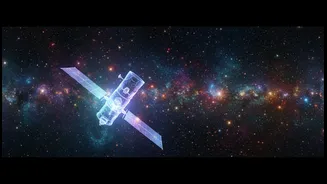
However, this doesn't mean the picture is simple. While the fundamental law of gravity holds true, its effects in such dense environments are incredibly complex. Studies have shown that simple gravitational pull alone doesn't explain everything we see. Over billions of years, gravity orchestrates a slow, intricate dance inside the cluster. Heavier stars tend to 'sink' towards the cluster's core, while lighter stars are pushed towards the periphery in a process called 'mass segregation'. Furthermore, the extreme stellar density leads to frequent close encounters and interactions between stars, which can disrupt binary systems and alter stellar orbits. Hubble's detailed observations allow astronomers to model these complex dynamics, refining our understanding of how gravity operates not just as a simple pull, but as the engine of a complex, evolving system.