







Beyond the Pale White
For too long, the ceiling has been an afterthought, coated in a standard flat white and promptly forgotten. This approach, a holdover from minimalist design movements, treats the ceiling as a functional boundary rather than a design opportunity. But today,
designers and homeowners are looking up, rediscovering the power of a statement ceiling. Treating this fifth wall as an integral part of your decor can add depth, create a focal point, and make a room feel more immersive and complete. It’s a design move that can deliver major impact, often with less effort and expense than redecorating an entire room.
Paint: The Simplest Statement
The most accessible way to embrace the fifth wall is with paint. A coat of colour can dramatically alter a room's mood. A dark, moody ceiling in a deep blue or charcoal grey can create a cozy, intimate feeling, especially in bedrooms or larger rooms with high ceilings. This might seem counterintuitive, but a dark colour can draw the eye upward and give a sense of infinite space, much like the night sky. Conversely, a light, cool colour like a pale blue or soft grey can make a room with a standard or low ceiling feel taller and more expansive. For a truly bold statement, consider a high-gloss finish to reflect light or a 'colour-drenched' approach where the walls, trim, and ceiling are all painted in the same hue for a seamless, immersive effect.
Wallpaper: A World of Pattern
If you crave more than a solid colour, wallpaper is your answer. Applying wallpaper to a ceiling is a definitive flex, turning the surface into a work of art. From bold geometric prints in a living room to delicate floral or cloud murals in a nursery, the options are endless. A patterned ceiling works particularly well in smaller spaces like powder rooms or entryways, where it can provide a burst of personality without overwhelming. For a cohesive, 'jewellery box' effect, you can even extend the same wallpaper from the walls onto the ceiling. While the application can be trickier than on walls due to gravity, modern 'paste-the-wall' wallpapers make the process much more manageable for a DIY project.
Texture and Architecture
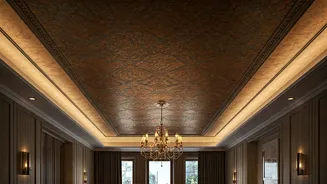
Beyond paint and paper, adding physical texture or architectural elements can give your ceiling a commanding presence. Options range from rustic to refined. Wooden planks or beams can add warmth and a farmhouse charm. Beadboard is another popular choice, lending a classic, vintage feel. For a more glamorous or industrial look, pressed tin or copper tiles offer shine and intricate patterns. In modern Indian homes, false ceilings made from Plaster of Paris (POP) or gypsum are frequently used to create multi-layered designs with integrated cove lighting. These can incorporate geometric cut-outs, backlit 'jaali' patterns, or elegant tray ceilings that add depth and sophistication.
Tips for a Flawless Fifth Wall
When planning your statement ceiling, consider the room's proportions. A busy, large-scale pattern might overwhelm a small room, while a delicate pattern could get lost in a room with very high ceilings. Good lighting is key, especially if you opt for a dark colour, to prevent the space from feeling like a cave. Always start with a properly prepped surface—clean, smooth, and primed—to ensure your paint or wallpaper adheres perfectly. And finally, take a cue from the rest of your decor. Repeating a colour from a rug or piece of art on the ceiling can create a cohesive and professionally designed look.