






An Ocean of Vapour in a Stellar Nursery
Astronomers recently made a remarkable discovery that is reshaping our understanding of how water-rich planets come to be. Using the Atacama Large Millimeter/submillimeter Array (ALMA) in Chile, scientists peered into the swirling disc of gas and dust
around a young, Sun-like star named HL Tauri, located 450 light-years away. In the inner region of this disc—exactly where rocky planets like Earth are expected to form—they detected a massive reservoir of water vapour. The amount was staggering: at least three times the volume of all the oceans on Earth, floating as gas in this planetary construction zone. This was not just a faint trace; it was a direct image of an ocean's worth of water available for planet-building from the very beginning. As one astronomer involved in the study noted, capturing an image of oceans of water vapour where a planet is likely forming was something they had never imagined possible.
The Old Theory: Water as a Late Arrival
For a long time, the leading hypothesis for Earth’s water was the “late delivery” model. The theory suggested that when the inner solar system first formed, it was too hot for water to condense. Therefore, early Earth was a dry, molten rock. Water, the theory proposed, arrived much later, delivered by a barrage of comets and asteroids from the colder, outer solar system that crashed into our young planet. This model depended on a chaotic and somewhat random game of cosmic billiards to bring life's most essential ingredient to the right place at the right time. While this process certainly happens, the idea that it is the only way for a planet to get its oceans has been thrown into question. The new discoveries suggest that waiting for a special delivery might not be necessary.
Born Wet: A New Blueprint for Water Worlds
The findings at HL Tauri provide strong evidence for a new, more direct pathway for creating ocean planets. Scientists now believe that dust grains in the cold, outer parts of a protoplanetary disc are coated with ice. Over time, these icy grains drift inward toward the star. When they cross a boundary known as the “snow line”—the point where the star's heat is intense enough to turn ice into gas—the water is released as enormous quantities of vapour. This process infuses the planet-forming region of the disc with water. Instead of forming dry and waiting for comets, nascent planets can now incorporate this abundant water vapour directly as they grow. It's less like having water delivered and more like building a house with the plumbing already included. This means a planet’s potential to host water is determined at its birth, not by a lucky celestial accident later on.
Expanding the Search for Habitable Planets
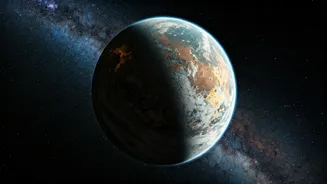
This paradigm shift has profound implications for the search for extraterrestrial life. If planets can be born with a built-in water supply, then worlds with oceans may be far more common throughout the galaxy than previously imagined. The classic “habitable zone” has long been defined as the narrow orbital band around a star where surface temperatures allow for liquid water. But this new understanding broadens the possibilities. Planets that might have otherwise been considered too dry could have vast internal oceans, sustained by heat from their core. The focus is shifting from simply finding Earth-like planets in perfect orbits to understanding the diverse ways that planets can acquire and retain water. The discovery of this cosmic water vapour fundamentally boosts the odds that somewhere out there, other ocean worlds are waiting to be found, born from the same watery blueprint.