







The Challenge of Cosmic Pinball
Imagine trying to predict the exact path of a tiny rock flicked across a massive, invisible cosmic table. Now, imagine there are millions of these rocks. That’s the challenge facing astronomers who track Near-Earth Objects (NEOs). Most of these space
rocks follow predictable paths governed by the gravity of the Sun and planets. However, their journeys are not always so simple. Their vast number, varying sizes, and the immense distances involved make tracking them a complex undertaking. Scientists rely on mathematical models to forecast their trajectories, but these models are only as good as the data fed into them. With only around 20,000 of the estimated millions of near-Earth asteroids discovered, the task of finding and tracking them is a constant race against time.
When Gravity Isn't the Whole Story
While gravity is the main force orchestrating the dance of the cosmos, it's not the only one. For smaller asteroids, subtle, non-gravitational forces can significantly alter their orbits over time. One of the most important is the Yarkovsky effect. This occurs when an asteroid absorbs sunlight and re-radiates it as heat. This emission of thermal photons, however slight, creates a tiny push, like a minuscule, continuous rocket engine. Over millions of years, this gentle nudge can drastically change an asteroid's path, pushing it into a different orbit entirely. Other factors like solar radiation pressure and outgassing from comet-like asteroids also introduce unpredictability, making purely gravity-based models incomplete.
Introducing the Residual Plot
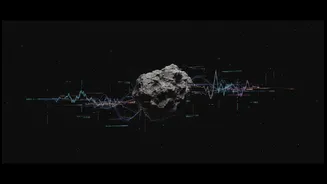
This is where a key statistical tool comes in: the residual plot. In simple terms, a residual is the difference between an asteroid's observed position and the position predicted by an orbital model. A residual plot is a graph that shows these differences over time. If a model is perfectly accurate, the residuals should be small and randomly scattered around zero. However, if the plot shows a pattern—like a curve or a trend—it's a clear signal that the model is missing something. That 'something' is often the subtle influence of non-gravitational forces. By analyzing these patterns, scientists can identify where their models are failing and work to improve them.
ESA's Toolkit for Planetary Defense
The European Space Agency's Near-Earth Object Coordination Centre (NEOCC) has developed a suite of powerful, freely available tools to help astronomers do just that. These tools, part of the NEO Toolkit, allow both professional and amateur astronomers to visualize asteroid orbits, plan observations, and chart their paths across the sky. By providing a centralized hub for data from telescopes worldwide, the NEOCC helps refine orbit determination and risk analysis. When new observations of an asteroid are made, they can be compared against the predicted path. The resulting residuals highlight any deviations, allowing for the model to be updated. This continuous cycle of observation, prediction, and refinement is crucial for improving the accuracy of asteroid tracking.
Why Better Models Matter
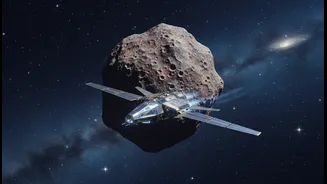
The ultimate goal of all this work is planetary defense. While the chances of a major asteroid impact at any given time are low, the potential consequences are enormous. The more accurately we can predict an asteroid's path decades in advance, the more options we have to mitigate a potential threat. Missions like NASA's DART have shown that deflecting an asteroid is possible, but this requires a long lead time. Tools that help scientists account for subtle effects like the Yarkovsky force are therefore not just academic exercises; they are essential components of our global early-warning system. They ensure that if a hazardous object is ever found to be on a collision course with Earth, we have the most precise information possible to act effectively.