





The Junkyard Above Our Heads
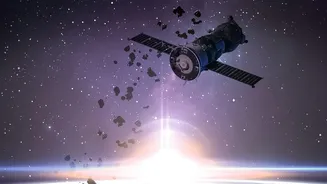
Imagine a highway with no traffic rules, where millions of vehicles and tiny pieces of shrapnel travel at over 28,000 kilometres per hour. That’s the reality of low-Earth orbit (LEO), the region of space where most of our satellites operate. Decades of space activity
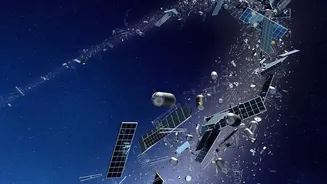
have left a hazardous legacy: a cloud of over a million objects larger than a centimetre, from defunct satellites and spent rocket stages to tiny fragments from past collisions. At orbital velocities, even a paint fleck can cause catastrophic damage to an active satellite, threatening billion-dollar investments and the vital services they provide. For India, which operates a significant fleet of Earth-observation, communication, and navigation satellites, this threat is not abstract. It's a constant, growing danger that requires a state-of-the-art defence system. The number of collision avoidance manoeuvres (CAMs) ISRO has to perform is rising dramatically, from just a handful a decade ago to a record 140 in 2025 alone, underscoring the escalating congestion.
India's High-Tech Guardian: Project NETRA
To counter this threat, the Indian Space Research Organisation (ISRO) established Project NETRA (NEtwork for space object TRacking and Analysis). This is India's indigenous capability to gain Space Situational Awareness (SSA), which means knowing what is in orbit, where it is, and where it's going. At the heart of this initiative is the ISRO System for Safe and Sustainable Space Operations Management (IS4OM), a dedicated control centre in Bengaluru. This facility acts as the nerve centre, processing data to protect India’s 50-plus operational satellites. Until the development of NETRA, India was largely reliant on data from foreign agencies like the US Space Command. Now, with its own network of radars and optical telescopes, India is building a self-reliant capacity to monitor its orbital neighbourhood.
How AI Predicts and Prevents Collisions
So where does Artificial Intelligence fit in? Manually tracking thousands of potential threats is impossible. ISRO receives hundreds of thousands of close-approach alerts annually from international partners. AI and machine learning algorithms are essential for sifting through this mountain of data to identify genuine collision risks. These intelligent systems analyse data from radar and telescopes, predict the future trajectories of debris, and calculate the probability of a collision. When the risk crosses a critical threshold — typically a 1 in 10,000 chance of impact — the system flags it for human operators. The AI-driven analysis provides the crucial information needed to perform a Collision Avoidance Manoeuvre (CAM), where a satellite fires its thrusters to make a small, precise adjustment to its orbit, nudging it safely out of the debris's path. This entire process, from detection to analysis and manoeuvre planning, is increasingly automated to handle the sheer volume of threats.
Protecting Our Eyes in the Sky
The satellites being protected are not just scientific instruments; they are vital national infrastructure. India’s Earth-observation satellites provide invaluable data for agriculture, urban planning, disaster management, and national security. They monitor weather patterns, track forest fires, manage water resources, and keep an eye on our borders. A collision could mean the loss of a priceless asset, disrupting these critical services and representing a significant economic and strategic setback. The increasing number of required avoidance manoeuvres comes at a cost, as each burn consumes precious fuel and shortens a satellite's operational lifespan. Therefore, an efficient AI-driven system that can accurately predict risks and avoid unnecessary manoeuvres is key to maximising the longevity and value of these orbiting sentinels.
The Future of Space Traffic Management
India’s investment in AI and SSA through Project NETRA is not just about defence; it’s about positioning itself as a responsible and leading spacefaring nation. As private companies like Digantara develop their own AI-powered surveillance systems, India's overall capability is set to grow. Looking ahead, ISRO has set a goal for debris-free space missions by 2030, reinforcing its commitment to sustainability. The future of space safety lies in automated, AI-powered systems that can predict and react to threats in real-time. By developing these capabilities, India is not only safeguarding its own assets but also contributing to the safety and sustainability of space for everyone. This home-grown expertise reduces reliance on other nations and cements India's status as a comprehensive space power, capable of not just launching missions but also managing them safely in an increasingly complex environment.