


A Long-Standing Solar Puzzle
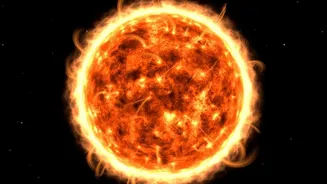
For nearly a century, scientists have been stumped by the coronal heating problem. Logic dictates that the temperature should decrease as you move away from a heat source, much like the air feels cooler the farther you are from a bonfire. Yet, the sun
defies this logic spectacularly. Its visible surface, the photosphere, registers temperatures around 6,000°C, while the tenuous corona millions of kilometres above sizzles at over a million degrees. This suggests that some unknown mechanism is actively pumping enormous amounts of energy into the sun's outer atmosphere, causing it to superheat. It's a fundamental question in astrophysics because understanding this process is key to understanding our star's behaviour, including the solar wind that constantly flows past Earth.
The Elusive Energy Messengers
One of the leading theories involves something called Alfvén waves. First predicted in 1942 by Nobel laureate Hannes Alfvén, these are a special type of magnetic wave that can travel through plasma, the super-hot, electrically charged gas that makes up the sun. Think of them as vibrations travelling along the sun’s magnetic field lines, like a pluck on a cosmic guitar string. The theory posits that these waves are generated by the churning, turbulent motion on the sun's surface and then travel outward, carrying vast amounts of energy into the corona. For decades, however, direct evidence of Alfvén waves with enough energy to account for the tremendous heat has been hard to find. Slower, lower-frequency waves had been detected, but they didn't seem powerful enough to solve the puzzle.
A Breakthrough Observation
This is where the recent discovery comes in. Using the high-resolution Extreme Ultraviolet Imager (EUI) aboard the European Space Agency's Solar Orbiter spacecraft, a team of researchers detected a previously hidden population of high-frequency Alfvén waves. These observations, focused on a polar region of the sun, were able to capture incredibly fine details and rapid movements that earlier instruments missed. The Solar Orbiter's advanced capabilities allowed it to resolve structures as small as 210 kilometres across and detect oscillations happening in mere seconds. In the data, the team identified thousands of these tiny, energetic transverse wave events rippling through the solar plasma, providing the most compelling evidence to date for this missing wave population.
Connecting Waves to Heat
The key finding is not just that these waves exist, but that they carry a significant amount of energy. The analysis showed that the wave power in the high-frequency range was more than double that of the lower-frequency waves previously observed. The theory is that as these high-frequency Alfvén waves travel up into the less dense corona, they break or dissipate, dumping their stored energy into the surrounding plasma and heating it to extreme temperatures. This process, known as turbulence, is similar to how crashing ocean waves release their energy onto a beach. The collision and interaction of these magnetic waves create turbulence that causes heating, providing a direct physical link between the wave activity and the corona's mysterious temperature.
What This Means for Solar Science
While this discovery is a major leap forward, it doesn't entirely close the book on the coronal heating problem. Scientists will now work to determine if the total energy carried by these newly detected waves is sufficient to account for all of the heating across the entire corona. Future observations, including coordinated efforts between spacecraft like the Solar Orbiter and NASA's Parker Solar Probe, will be crucial. By measuring the same solar wind at different distances from the sun, researchers can build a more complete picture of how this energy is transported and deposited. This new evidence validates a long-held theory and provides a clear path for future research, bringing us closer than ever to understanding the fundamental physics that drive our home star.